Using the EnsembleGPUKernel SDE solvers for the expectation of SDEs
Solving the SDEProblem using weak methods on multiple trajectories helps to generate the expectation of the stochastic process. With the lower overhead of EnsembleGPUKernel API, these calculations can be done in parallel on GPU, potentially being faster.
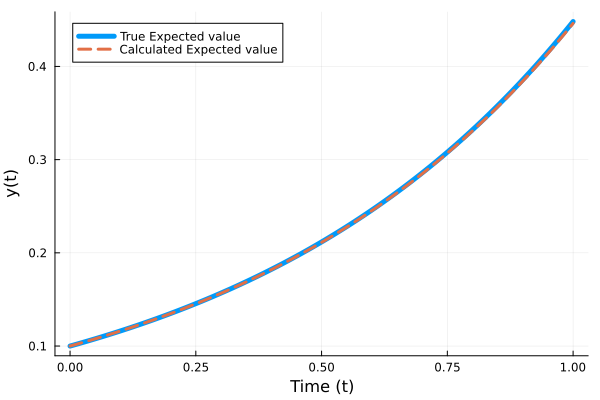
The example below provides a way to calculate the expectation time-series of a linear SDE:
using DiffEqGPU, OrdinaryDiffEq, StochasticDiffEq, StaticArrays, LinearAlgebra, Statistics
using CUDA

num_trajectories = 10_000

# Defining the Problem
# dX = pudt + qudW
u₀ = SA[0.1f0]
f(u, p, t) = SA[p[1] * u[1]]
g(u, p, t) = SA[p[2] * u[1]]
tspan = (0.0f0, 1.0f0)
p = SA[1.5f0, 0.01f0]

prob = SDEProblem(f, g, u₀, tspan, p; seed = 1234)

monteprob = EnsembleProblem(prob)

sol = solve(
    monteprob, GPUEM(), EnsembleGPUKernel(CUDA.CUDABackend(), 0.0),
    dt = Float32(1 // 2^8), trajectories = num_trajectories, adaptive = false
)

sol_array = Array(sol)

ts = sol.u[1].t

us_calc = reshape(mean(sol_array, dims = 3), size(sol_array, 2))

us_expect = u₀ .* exp.(p[1] * ts)

using Plots
plot(
    ts, us_expect, lw = 5,
    xaxis = "Time (t)", yaxis = "y(t)", label = "True Expected value"
)

plot!(ts, us_calc, lw = 3, ls = :dash, label = "Calculated Expected value")