Code Optimization for Differential Equations
See this FAQ for information on common pitfalls and how to improve performance.
Code Optimization in Julia
Before starting this tutorial, we recommend the reader to check out one of the many tutorials for optimization Julia code. The following is an incomplete list:
- The Julia Performance Tips
- MIT 18.337 Course Notes on Optimizing Serial Code
- What scientists must know about hardware to write fast code
User-side optimizations are important because, for sufficiently difficult problems, most time will be spent inside your f function, the function you are trying to solve. “Efficient” integrators are those that reduce the required number of f calls to hit the error tolerance. The main ideas for optimizing your DiffEq code, or any Julia function, are the following:
- Make it non-allocating
- Use StaticArrays for small arrays
- Use broadcast fusion
- Make it type-stable
- Reduce redundant calculations
- Make use of BLAS calls
- Optimize algorithm choice
We'll discuss these strategies in the context of differential equations. Let's start with small systems.
Example Accelerating a Non-Stiff Equation: The Lorenz Equation
Let's take the classic Lorenz system. Let's start by naively writing the system in its out-of-place form:
function lorenz(u, p, t)
    dx = 10.0 * (u[2] - u[1])
    dy = u[1] * (28.0 - u[3]) - u[2]
    dz = u[1] * u[2] - (8 / 3) * u[3]
    return [dx, dy, dz]
end
lorenz (generic function with 1 method)Here, lorenz returns an object, [dx,dy,dz], which is created within the body of lorenz.
This is a common code pattern from high-level languages like MATLAB, SciPy, or R's deSolve. However, the issue with this form is that it allocates a vector, [dx,dy,dz], at each step. Let's benchmark the solution process with this choice of function:
import DifferentialEquations as DE
import BenchmarkTools: @btime
u0 = [1.0; 0.0; 0.0]
tspan = (0.0, 100.0)
prob = DE.ODEProblem(lorenz, u0, tspan)
@btime DE.solve(prob, DE.Tsit5());
1.676 ms (203127 allocations: 7.85 MiB)The BenchmarkTools.jl package's @benchmark runs the code multiple times to get an accurate measurement. The minimum time is the time it takes when your OS and other background processes aren't getting in the way. Notice that in this case it takes about 5ms to solve and allocates around 11.11 MiB. However, if we were to use this inside of a real user code, we'd see a lot of time spent doing garbage collection (GC) to clean up all the arrays we made. Even if we turn off saving, we have these allocations.
@btime DE.solve(prob, DE.Tsit5(); save_everystep = false); 1.464 ms (179770 allocations: 6.87 MiB)The problem, of course, is that arrays are created every time our derivative function is called. This function is called multiple times per step and is thus the main source of memory usage. To fix this, we can use the in-place form to make our code non-allocating:
function lorenz!(du, u, p, t)
    du[1] = 10.0 * (u[2] - u[1])
    du[2] = u[1] * (28.0 - u[3]) - u[2]
    du[3] = u[1] * u[2] - (8 / 3) * u[3]
    return
end
lorenz! (generic function with 1 method)Here, instead of creating an array each time, we utilized the cache array du. When the in-place form is used, DifferentialEquations.jl takes a different internal route that minimizes the internal allocations as well.
Notice that nothing is returned. When in in-place form, the ODE solver ignores the return. Instead, make sure that the original du array is mutated instead of constructing a new array
When we benchmark this function, we will see quite a difference.
u0 = [1.0; 0.0; 0.0]
tspan = (0.0, 100.0)
prob = DE.ODEProblem(lorenz!, u0, tspan)
@btime DE.solve(prob, DE.Tsit5());
446.023 μs (22540 allocations: 970.68 KiB)@btime DE.solve(prob, DE.Tsit5(); save_everystep = false); 251.807 μs (83 allocations: 4.27 KiB)There is a 16x time difference just from that change! Notice there are still some allocations and this is due to the construction of the integration cache. But this doesn't scale with the problem size:
tspan = (0.0, 500.0) # 5x longer than before
prob = DE.ODEProblem(lorenz!, u0, tspan)
@btime DE.solve(prob, DE.Tsit5(); save_everystep = false);
1.323 ms (83 allocations: 4.27 KiB)Since that's all setup allocations, the user-side optimization is complete.
Further Optimizations of Small Non-Stiff ODEs with StaticArrays
Allocations are only expensive if they are “heap allocations”. For a more in-depth definition of heap allocations, there are many sources online. But a good working definition is that heap allocations are variable-sized slabs of memory which have to be pointed to, and this pointer indirection costs time. Additionally, the heap has to be managed, and the garbage controllers has to actively keep track of what's on the heap.
However, there's an alternative to heap allocations, known as stack allocations. The stack is statically-sized (known at compile time) and thus its accesses are quick. Additionally, the exact block of memory is known in advance by the compiler, and thus re-using the memory is cheap. This means that allocating on the stack has essentially no cost!
Arrays have to be heap allocated because their size (and thus the amount of memory they take up) is determined at runtime. But there are structures in Julia which are stack-allocated. structs for example are stack-allocated “value-type”s. Tuples are a stack-allocated collection. The most useful data structure for DiffEq though is the StaticArray from the package StaticArrays.jl. These arrays have their length determined at compile-time. They are created using macros attached to normal array expressions, for example:
import StaticArrays: SA
A = SA[2.0, 3.0, 5.0]
typeof(A)
SVector{3, Float64} (alias for StaticArraysCore.SArray{Tuple{3}, Float64, 1, 3})Notice that the 3 after SVector gives the size of the SVector. It cannot be changed. Additionally, SVectors are immutable, so we have to create a new SVector to change values. But remember, we don't have to worry about allocations because this data structure is stack-allocated. SArrays have numerous extra optimizations as well: they have fast matrix multiplication, fast QR factorizations, etc. which directly make use of the information about the size of the array. Thus, when possible, they should be used.
Unfortunately, static arrays can only be used for sufficiently small arrays. After a certain size, they are forced to heap allocate after some instructions and their compile time balloons. Thus, static arrays shouldn't be used if your system has more than ~20 variables. Additionally, only the native Julia algorithms can fully utilize static arrays.
Let's ***optimize lorenz using static arrays***. Note that in this case, we want to use the out-of-place allocating form, but this time we want to output a static array:
function lorenz_static(u, p, t)
    dx = 10.0 * (u[2] - u[1])
    dy = u[1] * (28.0 - u[3]) - u[2]
    dz = u[1] * u[2] - (8 / 3) * u[3]
    return SA[dx, dy, dz]
end
lorenz_static (generic function with 1 method)To make the solver internally use static arrays, we simply give it a static array as the initial condition:
u0 = SA[1.0, 0.0, 0.0]
tspan = (0.0, 100.0)
prob = DE.ODEProblem(lorenz_static, u0, tspan)
@btime DE.solve(prob, DE.Tsit5());
204.546 μs (2609 allocations: 366.27 KiB)@btime DE.solve(prob, DE.Tsit5(); save_everystep = false); 163.245 μs (43 allocations: 2.91 KiB)And that's pretty much all there is to it. With static arrays, you don't have to worry about allocating, so use operations like * and don't worry about fusing operations (discussed in the next section). Do “the vectorized code” of R/MATLAB/Python and your code in this case will be fast, or directly use the numbers/values.
Example Accelerating a Stiff Equation: the Robertson Equation
For these next examples, let's solve the Robertson equations (also known as ROBER):
\[\begin{aligned} \frac{dy_1}{dt} &= -0.04y₁ + 10^4 y_2 y_3 \\ \frac{dy_2}{dt} &= 0.04 y_1 - 10^4 y_2 y_3 - 3×10^7 y_2^2 \\ \frac{dy_3}{dt} &= 3×10^7 y_2^2 \\ \end{aligned}\]
Given that these equations are stiff, non-stiff ODE solvers like DE.Tsit5 or DE.Vern9 will fail to solve these equations. The automatic algorithm will detect this and automatically switch to something more robust to handle these issues. For example:
import DifferentialEquations as DE
import Plots: plot
function rober!(du, u, p, t)
    y₁, y₂, y₃ = u
    k₁, k₂, k₃ = p
    du[1] = -k₁ * y₁ + k₃ * y₂ * y₃
    du[2] = k₁ * y₁ - k₂ * y₂^2 - k₃ * y₂ * y₃
    du[3] = k₂ * y₂^2
    return
end
prob = DE.ODEProblem(rober!, [1.0, 0.0, 0.0], (0.0, 1.0e5), [0.04, 3.0e7, 1.0e4])
sol = DE.solve(prob)
plot(sol, tspan = (1.0e-2, 1.0e5), xscale = :log10)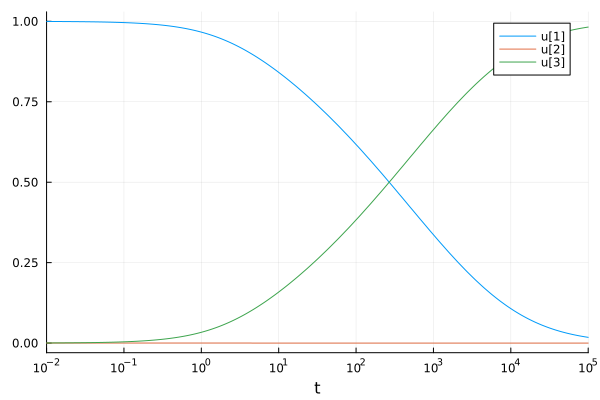
import BenchmarkTools: @btime
@btime DE.solve(prob);
82.133 μs (2450 allocations: 397.18 KiB)Choosing a Good Solver
Choosing a good solver is required for getting top-notch speed. General recommendations can be found on the solver page (for example, the ODE Solver Recommendations). The current recommendations can be simplified to a Rosenbrock method (Rosenbrock23 or Rodas5P, both from OrdinaryDiffEqRosenbrock; Rosenbrock23 and Rodas5P are in the default OrdinaryDiffEq re-export set, the rest of the Rosenbrock family — including Rodas5 — needs an explicit using OrdinaryDiffEqRosenbrock) for smaller (<50 ODEs) problems, ESDIRK methods for slightly larger (TRBDF2 or KenCarp4 from OrdinaryDiffEqSDIRK for <2000 ODEs), and QNDF (from OrdinaryDiffEqBDF) for even larger problems. lsoda from LSODA.jl is sometimes worth a try for the medium-sized category. Under DifferentialEquations.jl v8 the umbrella using DifferentialEquations only re-exports OrdinaryDiffEq's default solver set; non-default solvers must be imported from their host sublibrary.
More details on the solver to choose can be found by benchmarking. See the SciMLBenchmarks to compare many solvers on many problems.
From this, we try the recommendation of DE.Rosenbrock23() for stiff ODEs at default tolerances:
@btime DE.solve(prob, DE.Rosenbrock23()); 41.781 μs (669 allocations: 34.83 KiB)Declaring Jacobian Functions
In order to reduce the Jacobian construction cost, one can describe a Jacobian function by using the jac argument for the DE.ODEFunction. First we have to derive the Jacobian $\frac{df_i}{du_j}$ which is J[i,j]. From this, we get:
function rober_jac!(J, u, p, t)
    y₁, y₂, y₃ = u
    k₁, k₂, k₃ = p
    J[1, 1] = k₁ * -1
    J[2, 1] = k₁
    J[3, 1] = 0
    J[1, 2] = y₃ * k₃
    J[2, 2] = y₂ * k₂ * -2 + y₃ * k₃ * -1
    J[3, 2] = y₂ * 2 * k₂
    J[1, 3] = k₃ * y₂
    J[2, 3] = k₃ * y₂ * -1
    J[3, 3] = 0
    return
end
f! = DE.ODEFunction(rober!, jac = rober_jac!)
prob_jac = DE.ODEProblem(f!, [1.0, 0.0, 0.0], (0.0, 1.0e5), (0.04, 3.0e7, 1.0e4))
ODEProblem with uType Vector{Float64} and tType Float64. In-place: true
Non-trivial mass matrix: false
timespan: (0.0, 100000.0)
u0: 3-element Vector{Float64}:
1.0
0.0
0.0@btime DE.solve(prob_jac, DE.Rosenbrock23()); 35.710 μs (608 allocations: 31.98 KiB)Automatic Derivation of Jacobian Functions
But that was hard! If you want to take the symbolic Jacobian of numerical code, we can make use of ModelingToolkit.jl to symbolic-ify the numerical code and do the symbolic calculation and return the Julia code for this.
import ModelingToolkit as MTK
de = MTK.complete(MTK.modelingtoolkitize(prob))
\[ \begin{align} \frac{\mathrm{d} ~ \mathtt{x_1}\left( t \right)}{\mathrm{d}t} &= - \mathtt{x_1}\left( t \right) ~ \mathtt{\alpha_1} + \mathtt{x_2}\left( t \right) ~ \mathtt{x_3}\left( t \right) ~ \mathtt{\alpha_3} \\ \frac{\mathrm{d} ~ \mathtt{x_2}\left( t \right)}{\mathrm{d}t} &= \mathtt{x_1}\left( t \right) ~ \mathtt{\alpha_1} - \left( \mathtt{x_2}\left( t \right) \right)^{2} ~ \mathtt{\alpha_2} - \mathtt{x_2}\left( t \right) ~ \mathtt{x_3}\left( t \right) ~ \mathtt{\alpha_3} \\ \frac{\mathrm{d} ~ \mathtt{x_3}\left( t \right)}{\mathrm{d}t} &= \left( \mathtt{x_2}\left( t \right) \right)^{2} ~ \mathtt{\alpha_2} \end{align} \]
We can tell it to compute the Jacobian if we want to see the code:
MTK.generate_jacobian(de)[2] # Second is in-place:(function (__argₛᵧₘ1187374493630987813, ___mtkunknowns___, ___mtkparameters___, __argₛᵧₘ233450886303447812)
#= line 0 =# @inbounds begin
begin
begin
__mtk_arg_2 = begin
__miscₛᵧₘ0 = ___mtkparameters___[1]
end
__mtk_arg_3 = begin
__miscₛᵧₘ0 = ___mtkparameters___[2]
end
__mtk_arg_1 = begin
__miscₛᵧₘ0 = ___mtkunknowns___
end
local var"##cse#0" = __argₛᵧₘ1187374493630987813
__miscₛᵧₘ0 = 1
local var"##cse#1" = -1
local var"##cse#2" = __mtk_arg_2[1]
local var"##cse#3" = (*)(var"##cse#1", var"##cse#2")
__miscₛᵧₘ1 = 2
__miscₛᵧₘ2 = 3
local var"##cse#4" = 0
__miscₛᵧₘ3 = 4
local var"##cse#5" = ___mtkunknowns___[3]
local var"##cse#6" = __mtk_arg_2[3]
local var"##cse#7" = (*)(var"##cse#5", var"##cse#6")
__miscₛᵧₘ4 = 5
local var"##cse#8" = -2
local var"##cse#9" = ___mtkunknowns___[2]
local var"##cse#10" = __mtk_arg_2[2]
local var"##cse#11" = (*)(var"##cse#8", var"##cse#9", var"##cse#10")
local var"##cse#12" = (*)(var"##cse#1", var"##cse#5", var"##cse#6")
local var"##cse#13" = (+)(var"##cse#11", var"##cse#12")
__miscₛᵧₘ5 = 6
local var"##cse#14" = 2
local var"##cse#15" = (*)(var"##cse#14", var"##cse#9", var"##cse#10")
__miscₛᵧₘ6 = 7
local var"##cse#16" = (*)(var"##cse#9", var"##cse#6")
__miscₛᵧₘ7 = 8
local var"##cse#17" = (*)(var"##cse#1", var"##cse#9", var"##cse#6")
__miscₛᵧₘ8 = 9
__miscₛᵧₘ10 = #= line 0 =# @inbounds(begin
var"##cse#0"[__miscₛᵧₘ0] = var"##cse#3"
var"##cse#0"[__miscₛᵧₘ1] = var"##cse#2"
var"##cse#0"[__miscₛᵧₘ2] = var"##cse#4"
var"##cse#0"[__miscₛᵧₘ3] = var"##cse#7"
var"##cse#0"[__miscₛᵧₘ4] = var"##cse#13"
var"##cse#0"[__miscₛᵧₘ5] = var"##cse#15"
var"##cse#0"[__miscₛᵧₘ6] = var"##cse#16"
var"##cse#0"[__miscₛᵧₘ7] = var"##cse#17"
var"##cse#0"[__miscₛᵧₘ8] = var"##cse#4"
__miscₛᵧₘ9 = var"##cse#0"
end)
end
end
end
end)Now let's use that to give the analytical solution Jacobian:
prob_jac2 = DE.ODEProblem(de, [], (0.0, 1.0e5); jac = true)ODEProblem with uType Vector{Float64} and tType Float64. In-place: true
Initialization status: FULLY_DETERMINED
Non-trivial mass matrix: false
timespan: (0.0, 100000.0)
u0: 3-element Vector{Float64}:
1.0
0.0
0.0@btime DE.solve(prob_jac2); 225.396 μs (5211 allocations: 497.42 KiB)See the ModelingToolkit.jl documentation for more details.
Accelerating Small ODE Solves with Static Arrays
If the ODE is sufficiently small (<20 ODEs or so), using StaticArrays.jl for the state variables can greatly enhance the performance. This is done by making u0 a StaticArray and writing an out-of-place non-mutating dispatch for static arrays, for the ROBER problem, this looks like:
import StaticArrays: SA
function rober_static(u, p, t)
    y₁, y₂, y₃ = u
    k₁, k₂, k₃ = p
    du1 = -k₁ * y₁ + k₃ * y₂ * y₃
    du2 = k₁ * y₁ - k₂ * y₂^2 - k₃ * y₂ * y₃
    du3 = k₂ * y₂^2
    return SA[du1, du2, du3]
end
prob = DE.ODEProblem(
    rober_static, SA[1.0, 0.0, 0.0], (0.0, 1.0e5), SA[0.04, 3.0e7, 1.0e4]
)
sol = DE.solve(prob, DE.Rosenbrock23())
retcode: Success
Interpolation: specialized 2nd order "free" stiffness-aware interpolation
t: 61-element Vector{Float64}:
0.0
3.196206628740808e-5
0.00014400709669791316
0.00025605212710841824
0.00048593872520561496
0.0007179482298405134
0.0010819240431281
0.0014801655696439716
0.0020679567767069723
0.0028435846274559506
⋮
25371.934242574636
30784.11997687391
37217.42637183451
44850.61378119757
53893.69155452613
64593.73799781129
77241.71960460565
92180.81944906656
100000.0
u: 61-element Vector{StaticArraysCore.SVector{3, Float64}}:
[1.0, 0.0, 0.0]
[0.9999987215181657, 1.2780900152625978e-6, 3.9181897521319503e-10]
[0.9999942397327672, 5.718510591908378e-6, 4.175664083814195e-8]
[0.9999897579685716, 9.992106860321925e-6, 2.499245680985423e-7]
[0.99998056266788, 1.7833624284594367e-5, 1.6037078354141817e-6]
[0.9999712826600025, 2.403488607694387e-5, 4.682453920643883e-6]
[0.9999567250106862, 3.0390689558961382e-5, 1.2884299754832173e-5]
[0.999940798607161, 3.388427373871301e-5, 2.531711910029394e-5]
[0.9999172960308617, 3.583508668595173e-5, 4.686888245237194e-5]
[0.9998862913719596, 3.641240165367128e-5, 7.729622638673522e-5]
⋮
[0.05563507731000892, 2.3546320422346656e-7, 0.9443646872267862]
[0.047925348764047145, 2.0121495043224824e-7, 0.9520744500210009]
[0.04123342149003371, 1.71927881668911e-7, 0.9587664065820825]
[0.03543699837030759, 1.4688361975260185e-7, 0.9645628547460711]
[0.030425371816164174, 1.2546809318472792e-7, 0.9695745027157405]
[0.026099132201150267, 1.0715608431718063e-7, 0.9739007606427643]
[0.022369691694550272, 9.149844876161182e-8, 0.9776302168069994]
[0.019158563313533352, 7.811096380138788e-8, 0.980841358575501]
[0.01782789385075189, 7.258919982166399e-8, 0.9821720335600466]If we benchmark this, we see a really fast solution with really low allocation counts:
@btime sol = DE.solve(prob, DE.Rosenbrock23()); 18.351 μs (171 allocations: 21.30 KiB)This version is thus very amenable to multithreading and other forms of parallelism.
Example Accelerating Linear Algebra PDE Semi-Discretization
In this tutorial, we will optimize the right-hand side definition of a PDE semi-discretization.
We highly recommend looking at the Solving Large Stiff Equations tutorial for details on customizing DifferentialEquations.jl for more efficient large-scale stiff ODE solving. This section will only focus on the user-side code.
Let's optimize the solution of a Reaction-Diffusion PDE's discretization. In its discretized form, this is the ODE:
\[\begin{align*} du &= D_1 (A_y u + u A_x) + \frac{au^2}{v} + \bar{u} - α u\\ dv &= D_2 (A_y v + v A_x) + a u^2 + β v \end{align*}\]
where $u$, $v$, and $A$ are matrices. Here, we will use the simplified version where $A$ is the tridiagonal stencil $[1,-2,1]$, i.e. it's the 2D discretization of the Laplacian. The native code would be something along the lines of:
import DifferentialEquations as DE, LinearAlgebra as LA
import BenchmarkTools: @btime
# Generate the constants
p = (1.0, 1.0, 1.0, 10.0, 0.001, 100.0) # a,α,ubar,β,D1,D2
N = 100
Ax = Array(
    LA.Tridiagonal(
        [1.0 for i in 1:(N - 1)],
        [-2.0 for i in 1:N],
        [1.0 for i in 1:(N - 1)]
    )
)
Ay = copy(Ax)
Ax[2, 1] = 2.0
Ax[end - 1, end] = 2.0
Ay[1, 2] = 2.0
Ay[end, end - 1] = 2.0

function basic_version!(dr, r, p, t)
    a, α, ubar, β, D1, D2 = p
    u = r[:, :, 1]
    v = r[:, :, 2]
    Du = D1 * (Ay * u + u * Ax)
    Dv = D2 * (Ay * v + v * Ax)
    dr[:, :, 1] = Du .+ a .* u .* u ./ v .+ ubar .- α * u
    dr[:, :, 2] = Dv .+ a .* u .* u .- β * v
    return
end

a, α, ubar, β, D1, D2 = p
uss = (ubar + β) / α
vss = (a / β) * uss^2
r0 = zeros(100, 100, 2)
r0[:, :, 1] .= uss .+ 0.1 .* rand.()
r0[:, :, 2] .= vss

prob = DE.ODEProblem(basic_version!, r0, (0.0, 0.1), p)
ODEProblem with uType Array{Float64, 3} and tType Float64. In-place: true
Non-trivial mass matrix: false
timespan: (0.0, 0.1)
u0: 100×100×2 Array{Float64, 3}:
[:, :, 1] =
11.0498 11.0498 11.0159 11.0344 … 11.03 11.0214 11.0395 11.0628
11.0153 11.0784 11.0391 11.0617 11.0317 11.0446 11.024 11.0015
11.0215 11.067 11.0556 11.0936 11.0302 11.0079 11.0103 11.0706
11.0457 11.0698 11.0003 11.0897 11.0619 11.0808 11.0338 11.0202
11.0106 11.0732 11.0738 11.035 11.049 11.0968 11.0456 11.0257
11.0099 11.0031 11.0122 11.074 … 11.0944 11.0314 11.0519 11.0633
11.0042 11.0472 11.0176 11.0198 11.0567 11.0197 11.0473 11.0624
11.0235 11.0045 11.0996 11.0712 11.019 11.0771 11.0816 11.0819
11.0061 11.0968 11.0766 11.0925 11.0981 11.0288 11.073 11.0561
11.0297 11.0111 11.0289 11.0356 11.0386 11.061 11.0922 11.0654
⋮ ⋱
11.0078 11.071 11.0753 11.0474 11.0412 11.043 11.0101 11.0994
11.0905 11.0567 11.0337 11.0965 11.0264 11.0358 11.0595 11.0158
11.0167 11.0596 11.0508 11.0784 11.0257 11.0996 11.0877 11.0176
11.0337 11.0338 11.0417 11.0297 11.0638 11.0174 11.0291 11.0686
11.0925 11.0089 11.0858 11.085 … 11.018 11.0218 11.0086 11.0415
11.0089 11.0699 11.055 11.0795 11.0567 11.0041 11.0662 11.087
11.0923 11.008 11.0042 11.0147 11.086 11.0038 11.0755 11.0755
11.0422 11.0587 11.0109 11.048 11.0477 11.021 11.0612 11.0075
11.0125 11.026 11.0402 11.0046 11.0454 11.0641 11.0249 11.0051
[:, :, 2] =
12.1 12.1 12.1 12.1 12.1 12.1 … 12.1 12.1 12.1 12.1 12.1 12.1
12.1 12.1 12.1 12.1 12.1 12.1 12.1 12.1 12.1 12.1 12.1 12.1
12.1 12.1 12.1 12.1 12.1 12.1 12.1 12.1 12.1 12.1 12.1 12.1
12.1 12.1 12.1 12.1 12.1 12.1 12.1 12.1 12.1 12.1 12.1 12.1
12.1 12.1 12.1 12.1 12.1 12.1 12.1 12.1 12.1 12.1 12.1 12.1
12.1 12.1 12.1 12.1 12.1 12.1 … 12.1 12.1 12.1 12.1 12.1 12.1
12.1 12.1 12.1 12.1 12.1 12.1 12.1 12.1 12.1 12.1 12.1 12.1
12.1 12.1 12.1 12.1 12.1 12.1 12.1 12.1 12.1 12.1 12.1 12.1
12.1 12.1 12.1 12.1 12.1 12.1 12.1 12.1 12.1 12.1 12.1 12.1
12.1 12.1 12.1 12.1 12.1 12.1 12.1 12.1 12.1 12.1 12.1 12.1
⋮ ⋮ ⋱ ⋮
12.1 12.1 12.1 12.1 12.1 12.1 12.1 12.1 12.1 12.1 12.1 12.1
12.1 12.1 12.1 12.1 12.1 12.1 12.1 12.1 12.1 12.1 12.1 12.1
12.1 12.1 12.1 12.1 12.1 12.1 12.1 12.1 12.1 12.1 12.1 12.1
12.1 12.1 12.1 12.1 12.1 12.1 12.1 12.1 12.1 12.1 12.1 12.1
12.1 12.1 12.1 12.1 12.1 12.1 … 12.1 12.1 12.1 12.1 12.1 12.1
12.1 12.1 12.1 12.1 12.1 12.1 12.1 12.1 12.1 12.1 12.1 12.1
12.1 12.1 12.1 12.1 12.1 12.1 12.1 12.1 12.1 12.1 12.1 12.1
12.1 12.1 12.1 12.1 12.1 12.1 12.1 12.1 12.1 12.1 12.1 12.1
12.1 12.1 12.1 12.1 12.1 12.1 12.1 12.1 12.1 12.1 12.1 12.1In this version, we have encoded our initial condition to be a 3-dimensional array, with u[:,:,1] being the A part and u[:,:,2] being the B part.
@btime DE.solve(prob, DE.Tsit5()); 36.272 ms (9267 allocations: 194.52 MiB)While this version isn't very efficient,
We recommend writing the “high-level” code first, and iteratively optimizing it!
The first thing that we can do is get rid of the slicing allocations. The operation r[:,:,1] creates a temporary array instead of a “view”, i.e. a pointer to the already existing memory. To make it a view, add @view. Note that we have to be careful with views because they point to the same memory, and thus changing a view changes the original values:
A = rand(4)
@show A
B = @view A[1:3]
B[2] = 2
@show A
4-element Vector{Float64}:
0.9687811935737417
2.0
0.054179814018758155
0.0803821946545169Notice that changing B changed A. This is something to be careful of, but at the same time we want to use this since we want to modify the output dr. Additionally, the last statement is a purely element-wise operation, and thus we can make use of broadcast fusion there. Let's rewrite basic_version! to ***avoid slicing allocations*** and to ***use broadcast fusion***:
function gm2!(dr, r, p, t)
    a, α, ubar, β, D1, D2 = p
    u = @view r[:, :, 1]
    v = @view r[:, :, 2]
    du = @view dr[:, :, 1]
    dv = @view dr[:, :, 2]
    Du = D1 * (Ay * u + u * Ax)
    Dv = D2 * (Ay * v + v * Ax)
    @. du = Du + a .* u .* u ./ v + ubar - α * u
    @. dv = Dv + a .* u .* u - β * v
    return
end
prob = DE.ODEProblem(gm2!, r0, (0.0, 0.1), p)
@btime DE.solve(prob, DE.Tsit5());
30.577 ms (6972 allocations: 124.56 MiB)Now, most of the allocations are taking place in Du = D1*(Ay*u + u*Ax) since those operations are vectorized and not mutating. We should instead replace the matrix multiplications with LA.mul!. When doing so, we will need to have cache variables to write into. This looks like:
Ayu = zeros(N, N)
uAx = zeros(N, N)
Du = zeros(N, N)
Ayv = zeros(N, N)
vAx = zeros(N, N)
Dv = zeros(N, N)
function gm3!(dr, r, p, t)
    a, α, ubar, β, D1, D2 = p
    u = @view r[:, :, 1]
    v = @view r[:, :, 2]
    du = @view dr[:, :, 1]
    dv = @view dr[:, :, 2]
    LA.mul!(Ayu, Ay, u)
    LA.mul!(uAx, u, Ax)
    LA.mul!(Ayv, Ay, v)
    LA.mul!(vAx, v, Ax)
    @. Du = D1 * (Ayu + uAx)
    @. Dv = D2 * (Ayv + vAx)
    @. du = Du + a * u * u ./ v + ubar - α * u
    @. dv = Dv + a * u * u - β * v
    return
end
prob = DE.ODEProblem(gm3!, r0, (0.0, 0.1), p)
@btime DE.solve(prob, DE.Tsit5());
26.469 ms (3912 allocations: 31.09 MiB)But our temporary variables are global variables. We need to either declare the caches as const or localize them. We can localize them by adding them to the parameters, p. It's easier for the compiler to reason about local variables than global variables. ***Localizing variables helps to ensure type stability***.
p = (1.0, 1.0, 1.0, 10.0, 0.001, 100.0, Ayu, uAx, Du, Ayv, vAx, Dv) # a,α,ubar,β,D1,D2
function gm4!(dr, r, p, t)
    a, α, ubar, β, D1, D2, Ayu, uAx, Du, Ayv, vAx, Dv = p
    u = @view r[:, :, 1]
    v = @view r[:, :, 2]
    du = @view dr[:, :, 1]
    dv = @view dr[:, :, 2]
    LA.mul!(Ayu, Ay, u)
    LA.mul!(uAx, u, Ax)
    LA.mul!(Ayv, Ay, v)
    LA.mul!(vAx, v, Ax)
    @. Du = D1 * (Ayu + uAx)
    @. Dv = D2 * (Ayv + vAx)
    @. du = Du + a * u * u ./ v + ubar - α * u
    @. dv = Dv + a * u * u - β * v
    return
end
prob = DE.ODEProblem(gm4!, r0, (0.0, 0.1), p)
@btime DE.solve(prob, DE.Tsit5());
28.166 ms (1311 allocations: 30.88 MiB)We could then use the BLAS gemmv to optimize the matrix multiplications some more, but instead let's devectorize the stencil.
p = (1.0, 1.0, 1.0, 10.0, 0.001, 100.0, N)
function fast_gm!(du, u, p, t)
    a, α, ubar, β, D1, D2, N = p

    @inbounds for j in 2:(N - 1), i in 2:(N - 1)

        du[i, j, 1] = D1 *
            (
            u[i - 1, j, 1] + u[i + 1, j, 1] + u[i, j + 1, 1] + u[i, j - 1, 1] -
                4u[i, j, 1]
        ) +
            a * u[i, j, 1]^2 / u[i, j, 2] + ubar - α * u[i, j, 1]
    end

    @inbounds for j in 2:(N - 1), i in 2:(N - 1)

        du[i, j, 2] = D2 *
            (
            u[i - 1, j, 2] + u[i + 1, j, 2] + u[i, j + 1, 2] + u[i, j - 1, 2] -
                4u[i, j, 2]
        ) +
            a * u[i, j, 1]^2 - β * u[i, j, 2]
    end

    @inbounds for j in 2:(N - 1)
        i = 1
        du[1, j, 1] = D1 *
            (2u[i + 1, j, 1] + u[i, j + 1, 1] + u[i, j - 1, 1] - 4u[i, j, 1]) +
            a * u[i, j, 1]^2 / u[i, j, 2] + ubar - α * u[i, j, 1]
    end
    @inbounds for j in 2:(N - 1)
        i = 1
        du[1, j, 2] = D2 *
            (2u[i + 1, j, 2] + u[i, j + 1, 2] + u[i, j - 1, 2] - 4u[i, j, 2]) +
            a * u[i, j, 1]^2 - β * u[i, j, 2]
    end
    @inbounds for j in 2:(N - 1)
        i = N
        du[end, j, 1] = D1 *
            (2u[i - 1, j, 1] + u[i, j + 1, 1] + u[i, j - 1, 1] - 4u[i, j, 1]) +
            a * u[i, j, 1]^2 / u[i, j, 2] + ubar - α * u[i, j, 1]
    end
    @inbounds for j in 2:(N - 1)
        i = N
        du[end, j, 2] = D2 *
            (2u[i - 1, j, 2] + u[i, j + 1, 2] + u[i, j - 1, 2] - 4u[i, j, 2]) +
            a * u[i, j, 1]^2 - β * u[i, j, 2]
    end

    @inbounds for i in 2:(N - 1)
        j = 1
        du[i, 1, 1] = D1 *
            (u[i - 1, j, 1] + u[i + 1, j, 1] + 2u[i, j + 1, 1] - 4u[i, j, 1]) +
            a * u[i, j, 1]^2 / u[i, j, 2] + ubar - α * u[i, j, 1]
    end
    @inbounds for i in 2:(N - 1)
        j = 1
        du[i, 1, 2] = D2 *
            (u[i - 1, j, 2] + u[i + 1, j, 2] + 2u[i, j + 1, 2] - 4u[i, j, 2]) +
            a * u[i, j, 1]^2 - β * u[i, j, 2]
    end
    @inbounds for i in 2:(N - 1)
        j = N
        du[i, end, 1] = D1 *
            (u[i - 1, j, 1] + u[i + 1, j, 1] + 2u[i, j - 1, 1] - 4u[i, j, 1]) +
            a * u[i, j, 1]^2 / u[i, j, 2] + ubar - α * u[i, j, 1]
    end
    @inbounds for i in 2:(N - 1)
        j = N
        du[i, end, 2] = D2 *
            (u[i - 1, j, 2] + u[i + 1, j, 2] + 2u[i, j - 1, 2] - 4u[i, j, 2]) +
            a * u[i, j, 1]^2 - β * u[i, j, 2]
    end

    @inbounds begin
        i = 1
        j = 1
        du[1, 1, 1] = D1 * (2u[i + 1, j, 1] + 2u[i, j + 1, 1] - 4u[i, j, 1]) +
            a * u[i, j, 1]^2 / u[i, j, 2] + ubar - α * u[i, j, 1]
        du[1, 1, 2] = D2 * (2u[i + 1, j, 2] + 2u[i, j + 1, 2] - 4u[i, j, 2]) +
            a * u[i, j, 1]^2 - β * u[i, j, 2]

        i = 1
        j = N
        du[1, N, 1] = D1 * (2u[i + 1, j, 1] + 2u[i, j - 1, 1] - 4u[i, j, 1]) +
            a * u[i, j, 1]^2 / u[i, j, 2] + ubar - α * u[i, j, 1]
        du[1, N, 2] = D2 * (2u[i + 1, j, 2] + 2u[i, j - 1, 2] - 4u[i, j, 2]) +
            a * u[i, j, 1]^2 - β * u[i, j, 2]

        i = N
        j = 1
        du[N, 1, 1] = D1 * (2u[i - 1, j, 1] + 2u[i, j + 1, 1] - 4u[i, j, 1]) +
            a * u[i, j, 1]^2 / u[i, j, 2] + ubar - α * u[i, j, 1]
        du[N, 1, 2] = D2 * (2u[i - 1, j, 2] + 2u[i, j + 1, 2] - 4u[i, j, 2]) +
            a * u[i, j, 1]^2 - β * u[i, j, 2]

        i = N
        j = N
        du[end, end, 1] = D1 * (2u[i - 1, j, 1] + 2u[i, j - 1, 1] - 4u[i, j, 1]) +
            a * u[i, j, 1]^2 / u[i, j, 2] + ubar - α * u[i, j, 1]
        du[end, end, 2] = D2 * (2u[i - 1, j, 2] + 2u[i, j - 1, 2] - 4u[i, j, 2]) +
            a * u[i, j, 1]^2 - β * u[i, j, 2]
    end
    return
end
prob = DE.ODEProblem(fast_gm!, r0, (0.0, 0.1), p)
@btime DE.solve(prob, DE.Tsit5());
4.648 ms (699 allocations: 30.85 MiB)Notice that in this case fusing the loops and avoiding the linear operators is a major improvement of about 10x! That's an order of magnitude faster than our original MATLAB/SciPy/R vectorized style code!
Since this is tedious to do by hand, we note that ModelingToolkit.jl's symbolic code generation can do this automatically from the basic version:
import ModelingToolkit as MTK
function basic_version!(dr, r, p, t)
    a, α, ubar, β, D1, D2 = p
    u = r[:, :, 1]
    v = r[:, :, 2]
    Du = D1 * (Ay * u + u * Ax)
    Dv = D2 * (Ay * v + v * Ax)
    dr[:, :, 1] = Du .+ a .* u .* u ./ v .+ ubar .- α * u
    dr[:, :, 2] = Dv .+ a .* u .* u .- β * v
    return
end

a, α, ubar, β, D1, D2 = p
uss = (ubar + β) / α
vss = (a / β) * uss^2
r0 = zeros(100, 100, 2)
r0[:, :, 1] .= uss .+ 0.1 .* rand.()
r0[:, :, 2] .= vss

prob = DE.ODEProblem(basic_version!, r0, (0.0, 0.1), p)
de = MTK.complete(MTK.modelingtoolkitize(prob))

# Note jac=true,sparse=true makes it automatically build sparse Jacobian code
# as well!

fastprob = DE.ODEProblem(de, [], (0.0, 0.1); jac = true, sparse = true)
ODEProblem with uType Vector{Float64} and tType Float64. In-place: true
Initialization status: FULLY_DETERMINED
Non-trivial mass matrix: false
timespan: (0.0, 0.1)
u0: 20000-element Vector{Float64}:
11.086668629623757
11.056298029015016
11.03033621567392
11.067482234274047
11.059553198261527
11.03171325291029
11.087521488908159
11.013186203824905
11.093201662177684
11.077004443134932
⋮
12.100000000000001
12.100000000000001
12.100000000000001
12.100000000000001
12.100000000000001
12.100000000000001
12.100000000000001
12.100000000000001
12.100000000000001Lastly, we can do other things like multithread the main loops. LoopVectorization.jl provides the @turbo macro for doing a lot of SIMD enhancements, and @tturbo is the multithreaded version.
Optimizing Algorithm Choices
The last thing to do is then ***optimize our algorithm choice***. We have been using DE.Tsit5() as our test algorithm, but in reality this problem is a stiff PDE discretization and thus one recommendation is to use Sundials.CVODE_BDF(). However, instead of using the default dense Jacobian, we should make use of the sparse Jacobian afforded by the problem. The Jacobian is the matrix $\frac{df_i}{dr_j}$, where $r$ is read by the linear index (i.e. down columns). But since the $u$ variables depend on the $v$, the band size here is large, and thus this will not do well with a Banded Jacobian solver. Instead, we utilize sparse Jacobian algorithms. Sundials.CVODE_BDF allows us to use a sparse Newton-Krylov solver by setting linear_solver = :GMRES.
The Solving Large Stiff Equations tutorial goes through these details. This is simply to give a taste of how much optimization opportunity is left on the table!
Let's see how our fast right-hand side scales as we increase the integration time.
prob = DE.ODEProblem(fast_gm!, r0, (0.0, 10.0), p)
@btime DE.solve(prob, DE.Tsit5());
3.343 s (60159 allocations: 2.76 GiB)import Sundials: CVODE_BDF
@btime DE.solve(prob, CVODE_BDF(; linear_solver = :GMRES)); 425.919 ms (18069 allocations: 119.20 MiB)prob = DE.ODEProblem(fast_gm!, r0, (0.0, 100.0), p)
# Will go out of memory if we don't turn off `save_everystep`!
@btime DE.solve(prob, DE.Tsit5(); save_everystep = false); 3.263 s (103 allocations: 2.90 MiB)@btime DE.solve(prob, CVODE_BDF(; linear_solver = :GMRES); save_everystep = false); 1.183 s (42785 allocations: 2.44 MiB)prob = DE.ODEProblem(fast_gm!, r0, (0.0, 500.0), p)
@btime DE.solve(prob, CVODE_BDF(; linear_solver = :GMRES); save_everystep = false); 1.936 s (69833 allocations: 3.40 MiB)Notice that we've eliminated almost all allocations, allowing the code to grow without hitting garbage collection and slowing down.
Why is Sundials.CVODE_BDF doing well? What's happening is that, because the problem is stiff, the number of steps required by the explicit Runge-Kutta method grows rapidly, whereas Sundials.CVODE_BDF is taking large steps. Additionally, the GMRES linear solver form is quite an efficient way to solve the implicit system in this case. This is problem-dependent, and in many cases using a Krylov method effectively requires a preconditioner, so you need to play around with testing other algorithms and linear solvers to find out what works best with your problem.
Now continue to the Solving Large Stiff Equations tutorial for more details on optimizing the algorithm choice for such codes.