Linear Analysis
Linear analysis refers to the process of linearizing a nonlinear model and analysing the resulting linear dynamical system. To facilitate linear analysis, ModelingToolkit provides the concept of an AnalysisPoint, which can be inserted in-between two causal blocks (such as those from ModelingToolkitStandardLibrary.Blocks sub module). Once a model containing analysis points is built, several operations are available:
get_sensitivityget the sensitivity function (wiki), $S(s)$, as defined in the field of control theory.get_comp_sensitivityget the complementary sensitivity function $T(s) : S(s)+T(s)=1$.get_looptransferget the (open) loop-transfer function where the loop starts and ends in the analysis point. For a typical simple feedback connection with a plant $P(s)$ and a controller $C(s)$, the loop-transfer function at the plant output is $P(s)C(s)$.linearizecan be called with two analysis points denoting the input and output of the linearized system.open_loopreturn a new (nonlinear) system where the loop has been broken in the analysis point, i.e., the connection the analysis point usually implies has been removed.
An analysis point can be created explicitly using the constructor AnalysisPoint, or automatically when connecting two causal components using connect:
connect(comp1.output, :analysis_point_name, comp2.input)A single output can also be connected to multiple inputs:
connect(comp1.output, :analysis_point_name, comp2.input, comp3.input, comp4.input)Analysis points are causal, i.e., they imply a directionality for the flow of information. The order of the connections in the connect statement is thus important, i.e., connect(out, :name, in) is different from connect(in, :name, out).
The directionality of an analysis point can be thought of as an arrow in a block diagram, where the name of the analysis point applies to the arrow itself.
┌─────┐         ┌─────┐
│     │  name   │     │
│  out├────────►│in   │
│     │         │     │
└─────┘         └─────┘
This is signified by the name being the middle argument to connect.
An analysis point of a built model is referred to by property access on the system in which it was created, sys.analysis_point_name, and the functions above accept the AnalysisPoint this returns. A point belonging to a subsystem is reached through the hierarchy, sys.inner.analysis_point_name. The system must be the unsimplified and uncompleted model, since both mtkcompile and complete remove the analysis points.
Referring to an analysis point by its Symbol name, as in get_sensitivity(sys, :plant_input), is the old style and is retained only for backwards compatibility. It will be deprecated.
Of the above mentioned functions, all except for open_loop return the output of ModelingToolkit.linearize, which is
matrices, simplified_sys = linearize(_...)
# matrices = (; A, B, C, D)
i.e., matrices is a named tuple containing the matrices of a linear state-space system on the form
\[\begin{aligned} \dot x &= Ax + Bu\\ y &= Cx + Du \end{aligned}\]
Example
The following example builds a simple closed-loop system with a plant $P$ and a controller $C$. Two analysis points are inserted, one before and one after $P$. We then derive a number of sensitivity functions and show the corresponding code using the package ControlSystemBase.jl
using ModelingToolkitStandardLibrary.Blocks, ModelingToolkit
using ModelingToolkit: t_nounits as t

@named P = FirstOrder(k = 1, T = 1) # A first-order system with pole in -1
@named C = Gain(-1)             # A P controller

eqs = [connect(P.output, :plant_output, C.input)  # Connect with an automatically created analysis point called :plant_output
       connect(C.output, :plant_input, P.input)]
sys = System(eqs, t, systems = [P, C], name = :feedback_system)

matrices_S = get_sensitivity(sys, sys.plant_input)[1] # Compute the matrices of a state-space representation of the (input)sensitivity function.
matrices_T = get_comp_sensitivity(sys, sys.plant_input)[1]
(A = [-2.0;;], B = [-1.0;;], C = [-1.0;;], D = [0.0;;])Continued linear analysis and design can be performed using ControlSystemsBase.jl. We create ControlSystemsBase.StateSpace objects using
using ControlSystemsBase, Plots
S = ss(matrices_S...)
T = ss(matrices_T...)
bodeplot([S, T], lab = ["S" "" "T" ""], plot_title = "Bode plot of sensitivity functions",
    margin = 5Plots.mm)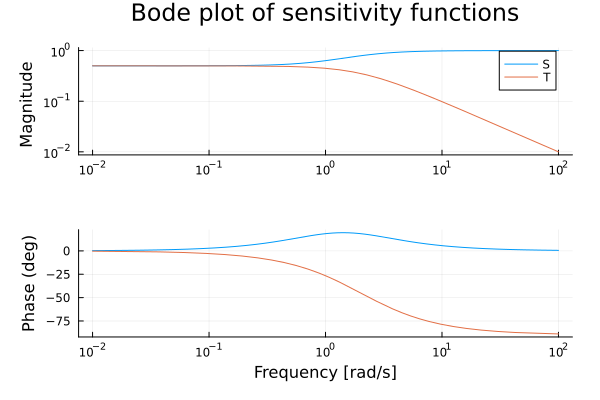
The sensitivity functions obtained this way should be equivalent to the ones obtained with the code below
using ControlSystemsBase
P = tf(1.0, [1, 1]) |> ss
C = 1                      # Negative feedback assumed in ControlSystems
S = sensitivity(P, C)      # or feedback(1, P*C)
T = comp_sensitivity(P, C) # or feedback(P*C)
ControlSystemsBase.StateSpace{ControlSystemsBase.Continuous, Float64}
A =
-2.0
B =
1.0
C =
1.0
D =
0.0
Continuous-time state-space modelWe may also derive the loop-transfer function $L(s) = P(s)C(s)$ using
matrices_L = get_looptransfer(sys, sys.plant_output)[1]
L = ss(matrices_L...)
ControlSystemsBase.StateSpace{ControlSystemsBase.Continuous, Float64}
A =
-1.0
B =
-1.0
C =
1.0
D =
0.0
Continuous-time state-space modelwhich is equivalent to the following with ControlSystems
L = P * (-C) # Add the minus sign to build the negative feedback into the controllerControlSystemsBase.StateSpace{ControlSystemsBase.Continuous, Float64}
A =
-1.0
B =
-1.0
C =
1.0
D =
-0.0
Continuous-time state-space modelTo obtain the transfer function between two analysis points, we call linearize
matrices_PS = linearize(sys, sys.plant_input, sys.plant_output)[1](A = [-2.0;;], B = [1.0;;], C = [1.0;;], D = [0.0;;])this particular transfer function should be equivalent to the linear system P(s)S(s), i.e., equivalent to
feedback(P, C)ControlSystemsBase.StateSpace{ControlSystemsBase.Continuous, Float64}
A =
-2.0
B =
1.0
C =
1.0
D =
0.0
Continuous-time state-space modelObtaining transfer functions
A statespace system from ControlSystemsBase can be converted to a transfer function using the function tf:
tf(S)ControlSystemsBase.TransferFunction{ControlSystemsBase.Continuous, ControlSystemsBase.SisoRational{Float64}}
1.0s + 1.0
----------
1.0s + 2.0
Continuous-time transfer function modelGain and phase margins
Further linear analysis can be performed using the analysis methods from ControlSystemsBase. For example, calculating the gain and phase margins of a system can be done using
margin(P)(wgm = [NaN;;], gm = [Inf;;], wpm = [-0.0;;], pm = [180.0;;])(they are infinite for this system). A Nyquist plot can be produced using
nyquistplot(P)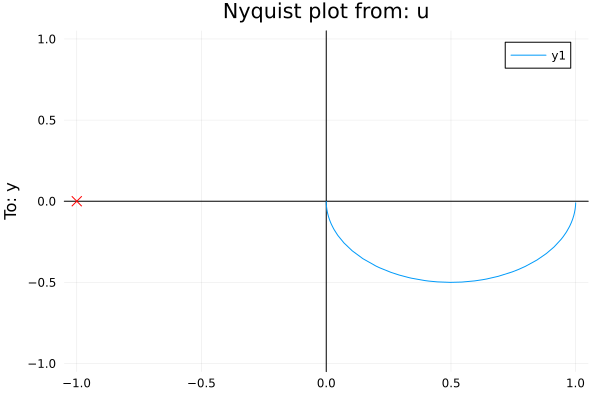
Operating Point of Unconnected Inputs After Loop Openings
When a connection is broken via loop_openings, the downstream input variable(s) that were previously driven by the connection become free. The value assigned to these inputs determines the operating point at which the linearization is computed, which is significant for nonlinear systems where the Jacobian depends on the operating point. Semantics: The variable introduced by a loop opening is treated as a parameter of the system, not as an additional input to the linearization. It does not appear as an extra column in the $B$ or $D$ matrices of the linearized state-space model. No default value is automatically propagated from the output side of the broken connection — the user is expected to provide the value explicitly via the operating point (e.g., op = [u => value]). For initialization, variables that become free due to loop openings are treated as solvable parameters: the initialization system always considers them as unknowns. If the user provides a value in the operating point, that value is used. If no value is provided, the initialization system will attempt to determine a consistent value, but the system may be underdetermined and a warning will be issued. Motivation: This design reflects a series of tradeoffs discovered through iteration:
- Defaulting free inputs to zero (the original behavior) is incorrect for nonlinear systems because it changes the linearization point relative to the equilibrium, potentially yielding meaningless results.
- Automatically propagating the output value of the broken connection preserves the correct operating point in some cases, makes it impossible to disconnect input sources (e.g., a Step signal). It also silently determines the operating point in a way that is difficult for the user to inspect or override.
- Making the variable a parameter (rather than a linearization input) prevents it from appearing as an extra input dimension in the linearized system. The user requested a linearization from specific inputs to specific outputs; the broken connection's input is not one of them.
- Requiring the user to explicitly provide the operating point for broken connections makes the linearization well-defined and inspectable. If the user wants the value that would have been present with the loop closed, they can determine this from a simulation or an initialization solution and pass it explicitly.
Index
ModelingToolkit.get_comp_sensitivity — Method
get_comp_sensitivity(sys, ap; loop_openings = [], system_modifier = identity, op = Dict(), kwargs...)Compute the complementary-sensitivity transfer matrices at analysis point ap and return (matrices, simplified_system, extras). This introduces an infinitesimal perturbation at the output of ap, linearizes the system, and computes the transfer function from the perturbation to the input of ap.
Arguments and keyword arguments match get_sensitivity, with kwargs... forwarded to get_comp_sensitivity_function.
See also get_sensitivity and get_looptransfer.
ModelingToolkit.get_comp_sensitivity_function — Method
get_comp_sensitivity_function(
    sys::ModelingToolkitBase.AbstractSystem,
    aps;
    kwargs...
) -> Tuple{ModelingToolkit.LinearizationFunction{_A, P, H, _B, J1, J2, J3, J4, IA, @NamedTuple{abstol::Float64, reltol::Float64, nlsolve_alg::Nothing}} where {_A, P<:ODEProblem, H<:FunctionWrappersWrappers.FunctionWrappersWrapper, _B, J1<:Union{Nothing, ModelingToolkit.PreparedJacobian{true, DifferentiationInterfaceForwardDiffExt.ForwardDiffTwoArgJacobianPrep{Nothing, C, Tuple{Nothing, Nothing}}, ModelingToolkit.UFFun{F}, _A, ADTypes.AutoForwardDiff{nothing, Nothing}} where {C<:(ForwardDiff.JacobianConfig{T, _A, _B, <:Tuple{Any, Any}} where {T<:(ForwardDiff.Tag{F} where F<:ModelingToolkit.UFFun), _A, _B}), F, _A}}, J2<:Union{Nothing, ModelingToolkit.PreparedJacobian{true, DifferentiationInterfaceForwardDiffExt.ForwardDiffTwoArgJacobianPrep{Nothing, C, Tuple{Nothing, Nothing}}, FunctionWrappersWrappers.FunctionWrappersWrapper{FW, P, CS}, _A, ADTypes.AutoForwardDiff{nothing, Nothing}} where {C<:(ForwardDiff.JacobianConfig{T, _A, _B, <:Tuple{Any, Any}} where {T<:(ForwardDiff.Tag{F} where F<:FunctionWrappersWrappers.FunctionWrappersWrapper), _A, _B}), FW, P, CS, _A}}, J3<:Union{Nothing, ModelingToolkit.PreparedJacobian{true, DifferentiationInterfaceForwardDiffExt.ForwardDiffTwoArgJacobianPrep{Nothing, C, Tuple{Nothing, Nothing, Nothing}}, ModelingToolkit.PFFun{_A, S}, _A1, ADTypes.AutoForwardDiff{nothing, Nothing}} where {C<:(ForwardDiff.JacobianConfig{T, _A, _B, <:Tuple{Any, Any}} where {T<:(ForwardDiff.Tag{F} where F<:(ModelingToolkit.PFFun{_A, S} where {_A, S<:(SymbolicIndexingInterface.OOPSetter{_A, System} where _A)})), _A, _B}), _A, S<:(SymbolicIndexingInterface.OOPSetter{_A, System} where _A), _A1}}, J4<:(ModelingToolkit.PreparedJacobian{true, DifferentiationInterfaceForwardDiffExt.ForwardDiffTwoArgJacobianPrep{Nothing, C, Tuple{Nothing, Nothing, Nothing}}, ModelingToolkit.HPFun{F, S}, _A, ADTypes.AutoForwardDiff{nothing, Nothing}} where {C<:(ForwardDiff.JacobianConfig{T, _A, _B, <:Tuple{Any, Any}} where {T<:(ForwardDiff.Tag{F} where F<:(ModelingToolkit.HPFun{F, S} where {F<:FunctionWrappersWrappers.FunctionWrappersWrapper, S<:(SymbolicIndexingInterface.OOPSetter{_A, System} where _A)})), _A, _B}), F<:FunctionWrappersWrappers.FunctionWrappersWrapper, S<:(SymbolicIndexingInterface.OOPSetter{_A, System} where _A), _A}), IA<:Union{SciMLBase.NoInit, SciMLBase.OverrideInit{Nothing, Nothing, Nothing}}}, System}
Return the complementary sensitivity function for the analysis point(s) aps, and the modified system simplified with the appropriate inputs and outputs.
Arguments
aps: An analysis point of the unsimplified, uncompleted systemsys, obtained assys.ap_name, or a vector of such points. A point belonging to a subsystem is reached through the hierarchy,sys.inner.ap_name. Passing theSymbolname of a point is the old style and will be deprecated.
Keyword Arguments
loop_openings: A list of analysis points whose connections should be removed and the outputs set to the input as a part of the linear analysis. Each entry is an analysis point of the unsimplified, uncompleted system, obtained assys.ap_name.system_modifier: A function taking the transformed system and applying any additional transformations, returning the modified system. The modified system is passed tolinearization_function.
All other keyword arguments are forwarded to linearization_function.
ModelingToolkit.get_looptransfer — Method
get_looptransfer(sys, ap; loop_openings = [], system_modifier = identity, op = Dict(), kwargs...)Compute the loop-transfer matrices at analysis point ap and return (matrices, simplified_system, extras). The transfer is from ap.out to ap.in.
Arguments and keyword arguments match get_sensitivity, with kwargs... forwarded to get_looptransfer_function.
The computed loop transfer includes negative feedback. Negate the result when using an analysis tool that expects a loop-transfer function without the negative gain.
See also get_sensitivity, get_comp_sensitivity, and open_loop.
ModelingToolkit.get_looptransfer_function — Method
get_looptransfer_function(
    sys::ModelingToolkitBase.AbstractSystem,
    aps;
    kwargs...
) -> Tuple{ModelingToolkit.LinearizationFunction{_A, P, H, _B, J1, J2, J3, J4, IA, @NamedTuple{abstol::Float64, reltol::Float64, nlsolve_alg::Nothing}} where {_A, P<:ODEProblem, H<:FunctionWrappersWrappers.FunctionWrappersWrapper, _B, J1<:Union{Nothing, ModelingToolkit.PreparedJacobian{true, DifferentiationInterfaceForwardDiffExt.ForwardDiffTwoArgJacobianPrep{Nothing, C, Tuple{Nothing, Nothing}}, ModelingToolkit.UFFun{F}, _A, ADTypes.AutoForwardDiff{nothing, Nothing}} where {C<:(ForwardDiff.JacobianConfig{T, _A, _B, <:Tuple{Any, Any}} where {T<:(ForwardDiff.Tag{F} where F<:ModelingToolkit.UFFun), _A, _B}), F, _A}}, J2<:Union{Nothing, ModelingToolkit.PreparedJacobian{true, DifferentiationInterfaceForwardDiffExt.ForwardDiffTwoArgJacobianPrep{Nothing, C, Tuple{Nothing, Nothing}}, FunctionWrappersWrappers.FunctionWrappersWrapper{FW, P, CS}, _A, ADTypes.AutoForwardDiff{nothing, Nothing}} where {C<:(ForwardDiff.JacobianConfig{T, _A, _B, <:Tuple{Any, Any}} where {T<:(ForwardDiff.Tag{F} where F<:FunctionWrappersWrappers.FunctionWrappersWrapper), _A, _B}), FW, P, CS, _A}}, J3<:Union{Nothing, ModelingToolkit.PreparedJacobian{true, DifferentiationInterfaceForwardDiffExt.ForwardDiffTwoArgJacobianPrep{Nothing, C, Tuple{Nothing, Nothing, Nothing}}, ModelingToolkit.PFFun{_A, S}, _A1, ADTypes.AutoForwardDiff{nothing, Nothing}} where {C<:(ForwardDiff.JacobianConfig{T, _A, _B, <:Tuple{Any, Any}} where {T<:(ForwardDiff.Tag{F} where F<:(ModelingToolkit.PFFun{_A, S} where {_A, S<:(SymbolicIndexingInterface.OOPSetter{_A, System} where _A)})), _A, _B}), _A, S<:(SymbolicIndexingInterface.OOPSetter{_A, System} where _A), _A1}}, J4<:(ModelingToolkit.PreparedJacobian{true, DifferentiationInterfaceForwardDiffExt.ForwardDiffTwoArgJacobianPrep{Nothing, C, Tuple{Nothing, Nothing, Nothing}}, ModelingToolkit.HPFun{F, S}, _A, ADTypes.AutoForwardDiff{nothing, Nothing}} where {C<:(ForwardDiff.JacobianConfig{T, _A, _B, <:Tuple{Any, Any}} where {T<:(ForwardDiff.Tag{F} where F<:(ModelingToolkit.HPFun{F, S} where {F<:FunctionWrappersWrappers.FunctionWrappersWrapper, S<:(SymbolicIndexingInterface.OOPSetter{_A, System} where _A)})), _A, _B}), F<:FunctionWrappersWrappers.FunctionWrappersWrapper, S<:(SymbolicIndexingInterface.OOPSetter{_A, System} where _A), _A}), IA<:Union{SciMLBase.NoInit, SciMLBase.OverrideInit{Nothing, Nothing, Nothing}}}, System}
Return the loop-transfer function for the analysis point(s) aps, and the modified system simplified with the appropriate inputs and outputs.
Arguments
aps: An analysis point of the unsimplified, uncompleted systemsys, obtained assys.ap_name, or a vector of such points. A point belonging to a subsystem is reached through the hierarchy,sys.inner.ap_name. Passing theSymbolname of a point is the old style and will be deprecated.
Keyword Arguments
loop_openings: A list of analysis points whose connections should be removed and the outputs set to the input as a part of the linear analysis. Each entry is an analysis point of the unsimplified, uncompleted system, obtained assys.ap_name.system_modifier: A function taking the transformed system and applying any additional transformations, returning the modified system. The modified system is passed tolinearization_function.
All other keyword arguments are forwarded to linearization_function.
ModelingToolkit.get_sensitivity — Method
get_sensitivity(sys, ap; loop_openings = [], system_modifier = identity, op = Dict(), kwargs...)Compute the sensitivity transfer matrices at analysis point ap and return (matrices, simplified_system, extras). This introduces an infinitesimal perturbation at the input of ap, linearizes the system, and computes the transfer function from the perturbation to the output of ap.
Arguments
sys: The unsimplified, uncompleted system containing the analysis point. Bothmtkcompileandcompleteremove the analysis points, so neither may have been applied tosys.ap: AnAnalysisPoint, obtained by property access onsys, as inget_sensitivity(sys, sys.plant_input). A point belonging to a subsystem is reached through the hierarchy,sys.inner.plant_input. Passing theSymbolname of the point,get_sensitivity(sys, :plant_input), is the old style and will be deprecated.
Keyword Arguments
loop_openings: connections to open before linearization.system_modifier: transformation applied before linearization.op: operating-point values passed tolinearize.allow_input_derivatives: allow derivatives of input variables in the linearization.t: time at which to evaluate the linearization.kwargs...: forwarded toget_sensitivity_function.
See also get_comp_sensitivity and get_looptransfer.
ModelingToolkit.get_sensitivity_function — Method
get_sensitivity_function(
    sys::ModelingToolkitBase.AbstractSystem,
    aps;
    kwargs...
) -> Tuple{ModelingToolkit.LinearizationFunction{_A, P, H, _B, J1, J2, J3, J4, IA, @NamedTuple{abstol::Float64, reltol::Float64, nlsolve_alg::Nothing}} where {_A, P<:ODEProblem, H<:FunctionWrappersWrappers.FunctionWrappersWrapper, _B, J1<:Union{Nothing, ModelingToolkit.PreparedJacobian{true, DifferentiationInterfaceForwardDiffExt.ForwardDiffTwoArgJacobianPrep{Nothing, C, Tuple{Nothing, Nothing}}, ModelingToolkit.UFFun{F}, _A, ADTypes.AutoForwardDiff{nothing, Nothing}} where {C<:(ForwardDiff.JacobianConfig{T, _A, _B, <:Tuple{Any, Any}} where {T<:(ForwardDiff.Tag{F} where F<:ModelingToolkit.UFFun), _A, _B}), F, _A}}, J2<:Union{Nothing, ModelingToolkit.PreparedJacobian{true, DifferentiationInterfaceForwardDiffExt.ForwardDiffTwoArgJacobianPrep{Nothing, C, Tuple{Nothing, Nothing}}, FunctionWrappersWrappers.FunctionWrappersWrapper{FW, P, CS}, _A, ADTypes.AutoForwardDiff{nothing, Nothing}} where {C<:(ForwardDiff.JacobianConfig{T, _A, _B, <:Tuple{Any, Any}} where {T<:(ForwardDiff.Tag{F} where F<:FunctionWrappersWrappers.FunctionWrappersWrapper), _A, _B}), FW, P, CS, _A}}, J3<:Union{Nothing, ModelingToolkit.PreparedJacobian{true, DifferentiationInterfaceForwardDiffExt.ForwardDiffTwoArgJacobianPrep{Nothing, C, Tuple{Nothing, Nothing, Nothing}}, ModelingToolkit.PFFun{_A, S}, _A1, ADTypes.AutoForwardDiff{nothing, Nothing}} where {C<:(ForwardDiff.JacobianConfig{T, _A, _B, <:Tuple{Any, Any}} where {T<:(ForwardDiff.Tag{F} where F<:(ModelingToolkit.PFFun{_A, S} where {_A, S<:(SymbolicIndexingInterface.OOPSetter{_A, System} where _A)})), _A, _B}), _A, S<:(SymbolicIndexingInterface.OOPSetter{_A, System} where _A), _A1}}, J4<:(ModelingToolkit.PreparedJacobian{true, DifferentiationInterfaceForwardDiffExt.ForwardDiffTwoArgJacobianPrep{Nothing, C, Tuple{Nothing, Nothing, Nothing}}, ModelingToolkit.HPFun{F, S}, _A, ADTypes.AutoForwardDiff{nothing, Nothing}} where {C<:(ForwardDiff.JacobianConfig{T, _A, _B, <:Tuple{Any, Any}} where {T<:(ForwardDiff.Tag{F} where F<:(ModelingToolkit.HPFun{F, S} where {F<:FunctionWrappersWrappers.FunctionWrappersWrapper, S<:(SymbolicIndexingInterface.OOPSetter{_A, System} where _A)})), _A, _B}), F<:FunctionWrappersWrappers.FunctionWrappersWrapper, S<:(SymbolicIndexingInterface.OOPSetter{_A, System} where _A), _A}), IA<:Union{SciMLBase.NoInit, SciMLBase.OverrideInit{Nothing, Nothing, Nothing}}}, System}
Return the sensitivity function for the analysis point(s) aps, and the modified system simplified with the appropriate inputs and outputs.
Arguments
aps: An analysis point of the unsimplified, uncompleted systemsys, obtained assys.ap_name, or a vector of such points. A point belonging to a subsystem is reached through the hierarchy,sys.inner.ap_name. Passing theSymbolname of a point is the old style and will be deprecated.
Keyword Arguments
loop_openings: A list of analysis points whose connections should be removed and the outputs set to the input as a part of the linear analysis. Each entry is an analysis point of the unsimplified, uncompleted system, obtained assys.ap_name.system_modifier: A function taking the transformed system and applying any additional transformations, returning the modified system. The modified system is passed tolinearization_function.
All other keyword arguments are forwarded to linearization_function.
ModelingToolkit.isolate_subsystem — Method
sys, input_vars, output_vars = isolate_subsystem(sys, input_aps, output_aps)Isolate the part of the unsimplified, hierarchical system sys bounded by the input analysis points input_aps and the output analysis points output_aps. The returned sys contains only the subsystems between the boundary analysis points at every level of the hierarchy; all upstream and downstream components, and all equations involving them, are removed.
The boundary points are obtained as sys.ap_name, or sys.inner.ap_name for a point belonging to a subsystem, and each argument accepts a single point or a vector of points. Passing the Symbol names of the points is the old style and will be deprecated. sys must not have been passed through mtkcompile or complete, both of which remove the analysis points.
Boundary analysis points may reside at any level of the hierarchy and in different branches of the subsystem tree.
Returns:
sys: The system with only the isolated subsystems and their internal connections.input_vars: Variables at the inside face of each input analysis point.output_vars: Variables at the inside face of each output analysis point.
ModelingToolkit.linearization_ap_transform — Method
sys, input_vars, output_vars =linearization_ap_transform(
sys,
inputs::Union{Vector{Symbol}, Vector{AnalysisPoint}, Symbol, AnalysisPoint},
outputs,
loop_openings
) -> Tuple{Any, Vector{SymbolicUtils.BasicSymbolicImpl.var"typeof(BasicSymbolicImpl)"{SymReal}}, Vector{SymbolicUtils.BasicSymbolicImpl.var"typeof(BasicSymbolicImpl)"{SymReal}}, Vector{SymbolicUtils.BasicSymbolicImpl.var"typeof(BasicSymbolicImpl)"{SymReal}}}
Apply analysis-point transformations to prepare a system for linearization.
inputs, outputs and loop_openings are analysis points of the unsimplified, uncompleted system sys, obtained as sys.ap_name, or vectors of such points. Passing the Symbol names of the points is the old style and will be deprecated.
Returns
sys: The transformed system.input_vars: A vector of input variables corresponding to the input analysis points.output_vars: A vector of output variables corresponding to the output analysis points.loop_opening_params: A vector of the variables that were turned into parameters by theloop_openings(their operating-point values must be supplied when linearizing).