Specifying and Solving PDESystems with Physics-Informed Neural Networks (PINNs)
In this example, we will solve a Poisson equation:
\[∂^2_x u(x, y) + ∂^2_y u(x, y) = - \sin(\pi x) \sin(\pi y) \, ,\]
with the boundary conditions:
\[\begin{align*} u(0, y) &= 0 \, ,\\ u(1, y) &= 0 \, ,\\ u(x, 0) &= 0 \, ,\\ u(x, 1) &= 0 \, , \end{align*}\]
on the space domain:
\[x \in [0, 1] \, , \ y \in [0, 1] \, ,\]
Using physics-informed neural networks.
Copy-Pasteable Code
using ModelingToolkit, NeuralPDE, SciMLBase, Lux, Optimization, OptimizationOptimJL, LineSearches, Plots
using Optim: LBFGS
using DomainSets: Interval
using IntervalSets: leftendpoint, rightendpoint

@parameters x y
@variables u(..)
Dxx = Differential(x)^2
Dyy = Differential(y)^2

# 2D PDE
eq = Dxx(u(x, y)) + Dyy(u(x, y)) ~ -sin(pi * x) * sin(pi * y)

# Boundary conditions
bcs = [
    u(0, y) ~ 0.0, u(1, y) ~ 0.0,
    u(x, 0) ~ 0.0, u(x, 1) ~ 0.0
]
# Space domains
domains = [x ∈ Interval(0.0, 1.0), y ∈ Interval(0.0, 1.0)]

# Neural network
dim = 2 # number of dimensions
chain = Chain(Dense(dim, 16, σ), Dense(16, 16, σ), Dense(16, 1))

# Discretization
discretization = PhysicsInformedNN(
    chain, QuadratureTraining(; batch = 200, abstol = 1e-6, reltol = 1e-6))

@named pde_system = PDESystem(eq, bcs, domains, [x, y], [u(x, y)])
prob = discretize(pde_system, discretization)

#Callback function
callback = function (p, l)
    println("Current loss is: $l")
    return false
end

# Optimizer
opt = LBFGS(linesearch = BackTracking())
res = solve(prob, opt, maxiters = 1000)
phi = discretization.phi

dx = 0.05
xs, ys = [leftendpoint(d.domain):(dx / 10):rightendpoint(d.domain) for d in domains]
analytic_sol_func(x, y) = (sin(pi * x) * sin(pi * y)) / (2pi^2)

u_predict = reshape([first(phi([x, y], res.u)) for x in xs for y in ys],
    (length(xs), length(ys)))
u_real = reshape([analytic_sol_func(x, y) for x in xs for y in ys],
    (length(xs), length(ys)))
diff_u = abs.(u_predict .- u_real)

p1 = plot(xs, ys, u_real, linetype = :contourf, title = "analytic");
p2 = plot(xs, ys, u_predict, linetype = :contourf, title = "predict");
p3 = plot(xs, ys, diff_u, linetype = :contourf, title = "error");
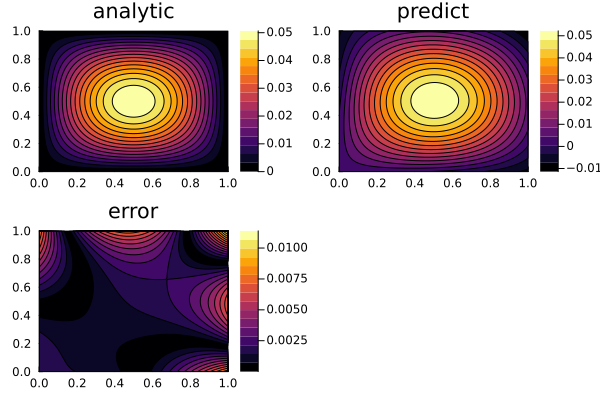
plot(p1, p2, p3)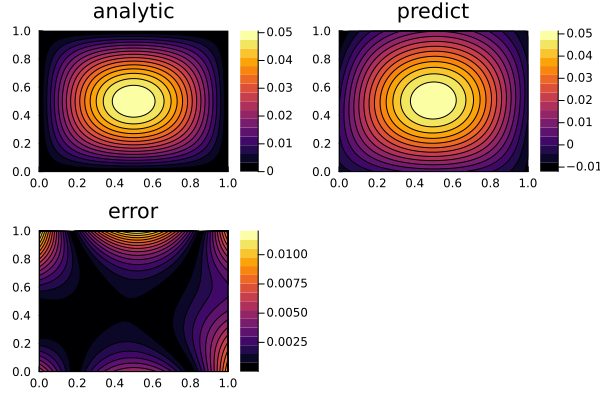
Detailed Description
The ModelingToolkit PDE interface for this example looks like this:
using ModelingToolkit, NeuralPDE, SciMLBase, Lux, Optimization, OptimizationOptimJL
using DomainSets: Interval
using IntervalSets: leftendpoint, rightendpoint
using Plots

@parameters x y
@variables u(..)
Dxx = Differential(x)^2
Dyy = Differential(y)^2

# 2D PDE
eq = Dxx(u(x, y)) + Dyy(u(x, y)) ~ -sin(pi * x) * sin(pi * y)

# Boundary conditions
bcs = [u(0, y) ~ 0.0, u(1, y) ~ 0.0,
    u(x, 0) ~ 0.0, u(x, 1) ~ 0.0]
# Space domains
domains = [x ∈ Interval(0.0, 1.0),
    y ∈ Interval(0.0, 1.0)]
2-element Vector{Symbolics.VarDomainPairing}:
Symbolics.VarDomainPairing(x, 0.0 .. 1.0)
Symbolics.VarDomainPairing(y, 0.0 .. 1.0)Here, we define the neural network, where the input of NN equals the number of dimensions and output equals the number of equations in the system.
# Neural network
dim = 2 # number of dimensions
chain = Chain(Dense(dim, 16, σ), Dense(16, 16, σ), Dense(16, 1))
Chain(
layer_1 = Dense(2 => 16, σ), # 48 parameters
layer_2 = Dense(16 => 16, σ), # 272 parameters
layer_3 = Dense(16 => 1), # 17 parameters
) # Total: 337 parameters,
# plus 0 states.Here, we build PhysicsInformedNN algorithm where dx is the step of discretization where strategy stores information for choosing a training strategy.
discretization = PhysicsInformedNN(
    chain, QuadratureTraining(; batch = 200, abstol = 1e-6, reltol = 1e-6))
PhysicsInformedNN{Lux.Chain{@NamedTuple{layer_1::Lux.Dense{typeof(NNlib.σ), Int64, Int64, Nothing, Nothing, Static.True}, layer_2::Lux.Dense{typeof(NNlib.σ), Int64, Int64, Nothing, Nothing, Static.True}, layer_3::Lux.Dense{typeof(identity), Int64, Int64, Nothing, Nothing, Static.True}}, Nothing}, QuadratureTraining{Float64, Integrals.CubatureJLh}, Nothing, Nothing, NeuralPDE.Phi{LuxCore.StatefulLuxLayerImpl.StatefulLuxLayer{Val{true}, Lux.Chain{@NamedTuple{layer_1::Lux.Dense{typeof(NNlib.σ), Int64, Int64, Nothing, Nothing, Static.True}, layer_2::Lux.Dense{typeof(NNlib.σ), Int64, Int64, Nothing, Nothing, Static.True}, layer_3::Lux.Dense{typeof(identity), Int64, Int64, Nothing, Nothing, Static.True}}, Nothing}, Nothing, @NamedTuple{layer_1::@NamedTuple{}, layer_2::@NamedTuple{}, layer_3::@NamedTuple{}}}}, typeof(NeuralPDE.numeric_derivative), Bool, Nothing, Nothing, Nothing, Base.RefValue{Int64}, Base.Pairs{Symbol, Union{}, Nothing, @NamedTuple{}}}(Lux.Chain{@NamedTuple{layer_1::Lux.Dense{typeof(NNlib.σ), Int64, Int64, Nothing, Nothing, Static.True}, layer_2::Lux.Dense{typeof(NNlib.σ), Int64, Int64, Nothing, Nothing, Static.True}, layer_3::Lux.Dense{typeof(identity), Int64, Int64, Nothing, Nothing, Static.True}}, Nothing}((layer_1 = Dense(2 => 16, σ), layer_2 = Dense(16 => 16, σ), layer_3 = Dense(16 => 1)), nothing), QuadratureTraining{Float64, Integrals.CubatureJLh}(Integrals.CubatureJLh(0), 1.0e-6, 1.0e-6, 1000, 200), nothing, nothing, NeuralPDE.Phi{LuxCore.StatefulLuxLayerImpl.StatefulLuxLayer{Val{true}, Lux.Chain{@NamedTuple{layer_1::Lux.Dense{typeof(NNlib.σ), Int64, Int64, Nothing, Nothing, Static.True}, layer_2::Lux.Dense{typeof(NNlib.σ), Int64, Int64, Nothing, Nothing, Static.True}, layer_3::Lux.Dense{typeof(identity), Int64, Int64, Nothing, Nothing, Static.True}}, Nothing}, Nothing, @NamedTuple{layer_1::@NamedTuple{}, layer_2::@NamedTuple{}, layer_3::@NamedTuple{}}}}(LuxCore.StatefulLuxLayerImpl.StatefulLuxLayer{Val{true}, Lux.Chain{@NamedTuple{layer_1::Lux.Dense{typeof(NNlib.σ), Int64, Int64, Nothing, Nothing, Static.True}, layer_2::Lux.Dense{typeof(NNlib.σ), Int64, Int64, Nothing, Nothing, Static.True}, layer_3::Lux.Dense{typeof(identity), Int64, Int64, Nothing, Nothing, Static.True}}, Nothing}, Nothing, @NamedTuple{layer_1::@NamedTuple{}, layer_2::@NamedTuple{}, layer_3::@NamedTuple{}}}(Lux.Chain{@NamedTuple{layer_1::Lux.Dense{typeof(NNlib.σ), Int64, Int64, Nothing, Nothing, Static.True}, layer_2::Lux.Dense{typeof(NNlib.σ), Int64, Int64, Nothing, Nothing, Static.True}, layer_3::Lux.Dense{typeof(identity), Int64, Int64, Nothing, Nothing, Static.True}}, Nothing}((layer_1 = Dense(2 => 16, σ), layer_2 = Dense(16 => 16, σ), layer_3 = Dense(16 => 1)), nothing), nothing, (layer_1 = NamedTuple(), layer_2 = NamedTuple(), layer_3 = NamedTuple()), nothing, Val{true}())), NeuralPDE.numeric_derivative, false, nothing, nothing, nothing, LogOptions(50), Base.RefValue{Int64}(1), true, false, Base.Pairs{Symbol, Union{}, Nothing, @NamedTuple{}}())As described in the API docs, we now need to define the PDESystem and create PINNs problem using the discretize method.
@named pde_system = PDESystem(eq, bcs, domains, [x, y], [u(x, y)])
prob = discretize(pde_system, discretization)OptimizationProblem. In-place: true
u0: ComponentVector{Float64}(layer_1 = (weight = [0.08375447988510132 -0.5967907905578613; 0.42782270908355713 0.872321367263794; … ; 0.0034676690120249987 -0.009533717297017574; -1.0007095336914062 0.6368169784545898], bias = [0.1270909607410431, 0.3072810471057892, -0.1981438845396042, -0.020551815629005432, 0.3734991252422333, -0.24065682291984558, 0.6996813416481018, -0.3670753538608551, -0.027184801176190376, 0.5269156098365784, 0.2839653193950653, 0.2147660106420517, 0.0080880643799901, -0.3882733881473541, 0.5602274537086487, -0.367969810962677]), layer_2 = (weight = [0.31451937556266785 0.10531609505414963 … 0.41315722465515137 -0.06715778261423111; -0.32675620913505554 -0.13941770792007446 … 0.05422574654221535 -0.41918036341667175; … ; 0.160508930683136 -0.42016083002090454 … 0.36415499448776245 0.38822123408317566; -0.3573438823223114 -0.2760697305202484 … -0.09712517261505127 -0.039030931890010834], bias = [0.10208597779273987, -0.1613633930683136, -0.10111051797866821, -0.20791342854499817, 0.2127217948436737, -0.09781423211097717, 0.06384885311126709, -0.1398066282272339, -0.012032002210617065, -0.03995579481124878, -0.1676899492740631, -0.10276547074317932, 0.17093303799629211, 0.15839055180549622, 0.03131413459777832, -0.19758808612823486]), layer_3 = (weight = [-0.25383085012435913 -0.23597976565361023 … 0.2348274290561676 -0.13357478380203247], bias = [0.04524305462837219]))Here, we define the callback function and the optimizer. And now we can solve the PDE using PINNs (with the number of epochs maxiters=1000).
#Optimizer
opt = LBFGS(linesearch = BackTracking())

callback = function (p, l)
    println("Current loss is: $l")
    return false
end

# We can pass the callback function in the solve. Not doing here as the output would be very long.
res = Optimization.solve(prob, opt, maxiters = 1000)
phi = discretization.phi
NeuralPDE.Phi{LuxCore.StatefulLuxLayerImpl.StatefulLuxLayer{Val{true}, Lux.Chain{@NamedTuple{layer_1::Lux.Dense{typeof(NNlib.σ), Int64, Int64, Nothing, Nothing, Static.True}, layer_2::Lux.Dense{typeof(NNlib.σ), Int64, Int64, Nothing, Nothing, Static.True}, layer_3::Lux.Dense{typeof(identity), Int64, Int64, Nothing, Nothing, Static.True}}, Nothing}, Nothing, @NamedTuple{layer_1::@NamedTuple{}, layer_2::@NamedTuple{}, layer_3::@NamedTuple{}}}}(LuxCore.StatefulLuxLayerImpl.StatefulLuxLayer{Val{true}, Lux.Chain{@NamedTuple{layer_1::Lux.Dense{typeof(NNlib.σ), Int64, Int64, Nothing, Nothing, Static.True}, layer_2::Lux.Dense{typeof(NNlib.σ), Int64, Int64, Nothing, Nothing, Static.True}, layer_3::Lux.Dense{typeof(identity), Int64, Int64, Nothing, Nothing, Static.True}}, Nothing}, Nothing, @NamedTuple{layer_1::@NamedTuple{}, layer_2::@NamedTuple{}, layer_3::@NamedTuple{}}}(Lux.Chain{@NamedTuple{layer_1::Lux.Dense{typeof(NNlib.σ), Int64, Int64, Nothing, Nothing, Static.True}, layer_2::Lux.Dense{typeof(NNlib.σ), Int64, Int64, Nothing, Nothing, Static.True}, layer_3::Lux.Dense{typeof(identity), Int64, Int64, Nothing, Nothing, Static.True}}, Nothing}((layer_1 = Dense(2 => 16, σ), layer_2 = Dense(16 => 16, σ), layer_3 = Dense(16 => 1)), nothing), nothing, (layer_1 = NamedTuple(), layer_2 = NamedTuple(), layer_3 = NamedTuple()), nothing, Val{true}()))We can plot the predicted solution of the PDE and compare it with the analytical solution to plot the relative error.
dx = 0.05
xs, ys = [leftendpoint(d.domain):(dx / 10):rightendpoint(d.domain) for d in domains]
analytic_sol_func(x, y) = (sin(pi * x) * sin(pi * y)) / (2pi^2)

u_predict = reshape([first(phi([x, y], res.u)) for x in xs for y in ys],
    (length(xs), length(ys)))
u_real = reshape([analytic_sol_func(x, y) for x in xs for y in ys],
    (length(xs), length(ys)))
diff_u = abs.(u_predict .- u_real)

p1 = plot(xs, ys, u_real, linetype = :contourf, title = "analytic");
p2 = plot(xs, ys, u_predict, linetype = :contourf, title = "predict");
p3 = plot(xs, ys, diff_u, linetype = :contourf, title = "error");
plot(p1, p2, p3)