Sparse Direct Solver Comparison — Factorization and Cached Re-solve
Which sparse direct solver should you use? This benchmark compares every sparse LU backend LinearSolve.jl ships — including the new pure-Julia SupernodalLUFactorization (Schenk–Gärtner supernodal LU) — on finite-difference matrices in 1, 2, and 3 space dimensions, across sizes from 10 to ~40,000 unknowns.
Two costs are reported separately, because real workloads pay them differently:
- First solve —
init+ numeric factorization + triangular solve. What you pay the first time, or every time if you throw the factorization away. - Cached re-solve — a new right-hand side through the existing factorization via
solve!on the cache. This is the cost that dominates ODE/nonlinear workflows, and the reason LinearSolve'sinit/solve!API exists.
The Default line runs LinearProblem with no algorithm specified — it shows what LinearSolve's automatic selection actually picks for these matrices, so you can judge whether hand-picking is worth it.
CI budget note: the size sweep is bounded by kmax below (~40k unknowns max per dimension). Expected wall time is well under two hours on the benchmark runner; if sizes are raised, raise the folder timeout to match.
using BenchmarkTools, Random
using LinearAlgebra, SparseArrays, LinearSolve, Sparspak
# PureUMFPACK backs PureUMFPACKFactorization via LinearSolvePureUMFPACKExt.
# Use `import` (not `using`): PureUMFPACK ≤0.1 exports `solve`, which collides
# with LinearSolve/CommonSolve. PureKLU / SupernodalLU need no extra load.
import PureUMFPACK
import Pardiso
import ParU_jll
using Plots

BenchmarkTools.DEFAULT_PARAMETERS.seconds = 0.5
BenchmarkTools.DEFAULT_PARAMETERS.samples = 10

# Sparse matrix generation on an n-dimensional rectangular grid. After
# https://discourse.julialang.org/t/seven-lines-of-julia-examples-sought/50416/135
# by A. Braunstein (same generator as SparsePDE.jmd).

A ⊕ B = kron(I(size(B, 1)), A) + kron(B, I(size(A, 1)))

function lattice(n; Tv = Float64)
    d = fill(2 * one(Tv), n)
    d[1] = one(Tv)
    d[end] = one(Tv)
    spdiagm(1 => -ones(Tv, n - 1), 0 => d, -1 => -ones(Tv, n - 1))
end

lattice(L...; Tv = Float64) = lattice(L[1]; Tv) ⊕ lattice(L[2:end]...; Tv)

#
# Matrix like a finite difference discretization of ``-Δu + δu`` in a
# `dim`-dimensional unit cube with approximately N unknowns; strictly diagonally
# dominant, so every method here should succeed — and we verify that they do.
#
function fdmatrix(N; dim = 2, Tv = Float64, δ = 1.0e-2)
    n = N^(1 / dim) |> ceil |> Int
    lattice([n for i in 1:dim]...; Tv) + Tv(δ) * I
end

# `nothing` = LinearSolve's automatic default selection.
algs = [
    ("UMFPACK", UMFPACKFactorization()),
    ("KLU", KLUFactorization()),
    ("Pardiso", MKLPardisoFactorize()),
    ("Sparspak", SparspakFactorization()),
    ("PureKLU", PureKLUFactorization()),
    ("PureUMFPACK", PureUMFPACKFactorization()),
    # ParU is EXCLUDED from this sweep. Its METIS-based analysis routes every
    # allocation through Julia's counted-malloc path, and across many
    # factorizations this ratchets the GC's allocation accounting upward
    # irreversibly (GC.gc(true) does not reset it). Once tripped, EVERY
    # allocation-heavy code path in the process crawls — a later sweep wedged
    # inside SupernodalLU's symbolic analysis purely as collateral. Sub-second
    # solves become hours. See the LinearSolve.jl issue for the reproducer.
    ("SupernodalLU", SupernodalLUFactorization()),
    ("SupernodalLU (threaded)", SupernodalLUFactorization(threaded = true)),
    ("Default", nothing),
]
algnames = first.(algs)
cols = [:red, :blue, :green, :magenta, :gold, :brown, :turquoise, :orange, :black]
9-element Vector{Symbol}:
:red
:blue
:green
:magenta
:gold
:brown
:turquoise
:orange
:blackMethodology
For each matrix and algorithm we measure:
t_first:init+solve!from scratch, fresh per sample. Includes symbolic analysis, numeric factorization, and one triangular solve.t_resolve:solve!on the already-factorized cache. LinearSolve only refactors when the matrix changes, so this isolates the backsolve.
Every timed configuration is first checked for correctness (relative residual < 1e-8); a failing method is recorded as NaN and reported, never silently plotted. A fast wrong answer must not appear in these curves.
function bench_alg(A, b, alg)
    prob = LinearProblem(A, b)
    mk() = alg === nothing ? init(prob) : init(prob, alg)

    # Correctness gate before any timing.
    cache = mk()
    sol = solve!(cache)
    res = norm(A * sol.u - b) / norm(b)
    if !(res < 1e-8)
        @warn "correctness gate failed — omitting from plot" alg res
        return (first = NaN, resolve = NaN)
    end

    t_first = @belapsed solve!(c) setup=(c = $mk()) evals=1
    # `cache` is factorized above; repeated solve! reuses the factorization.
    t_resolve = @belapsed solve!($cache)

    return (first = t_first, resolve = t_resolve)
end

# kmax=12 gives ≈ 40_000 unknowns max — the historical bound this folder's sweeps
# have used (SparsePDE.jmd), chosen so 3-D KLU stays tractable.
function sweep(dim; kmax = 12)
    ns = [10 * 2^k for k in 0:kmax]
    tfirst = fill(NaN, length(ns), length(algs))
    tresolve = fill(NaN, length(ns), length(algs))
    sizes = zeros(Int, length(ns))
    for (i, N) in enumerate(ns)
        rng = MersenneTwister(123)
        A = fdmatrix(N; dim)
        n = size(A, 1)
        sizes[i] = n
        b = rand(rng, n)
        @info "dim=$dim: $n × $n, nnz=$(nnz(A))"
        for (j, (name, alg)) in enumerate(algs)
            try
                r = bench_alg(A, b, alg)
                tfirst[i, j] = r.first
                tresolve[i, j] = r.resolve
            catch e
                @warn "$(name) failed at n=$(n)" exception=(e,)
            end
        end
    end
    return (; sizes, tfirst, tresolve)
end

function plot_sweep(sizes, times, dim, phase)
    p = plot(;
        ylabel = "Time / s", xlabel = "N",
        yscale = :log10, xscale = :log10,
        title = "$(phase), $(dim)D FD matrix",
        legend = :outertopright)
    for j in 1:length(algs)
        mask = .!isnan.(times[:, j])
        any(mask) && plot!(p, sizes[mask], times[mask, j];
            linecolor = cols[j], marker = :circle, markersize = 2,
            label = algnames[j])
    end
    p
end
plot_sweep (generic function with 1 method)1D
r1 = sweep(1)
plot_sweep(r1.sizes, r1.tfirst, 1, "Factor + first solve")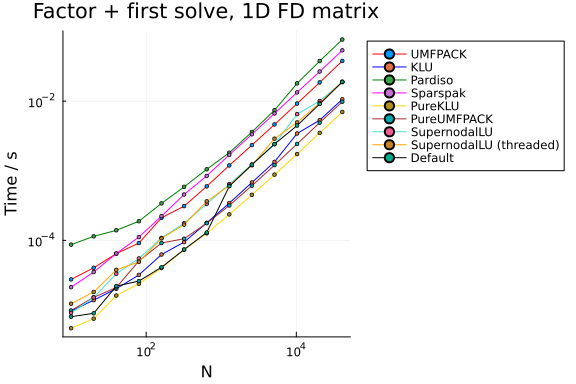
plot_sweep(r1.sizes, r1.tresolve, 1, "Cached re-solve")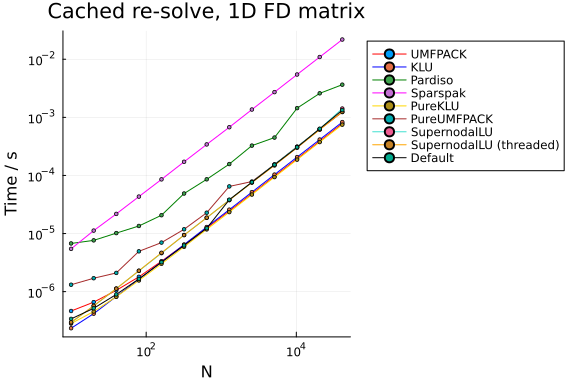
2D
r2 = sweep(2)
plot_sweep(r2.sizes, r2.tfirst, 2, "Factor + first solve")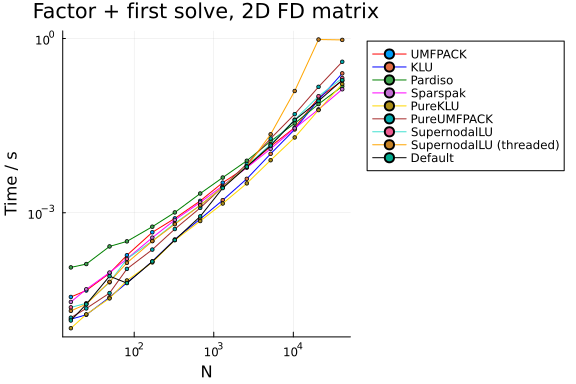
plot_sweep(r2.sizes, r2.tresolve, 2, "Cached re-solve")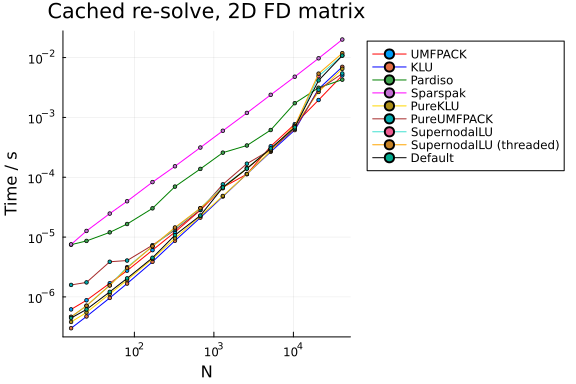
3D
r3 = sweep(3)
plot_sweep(r3.sizes, r3.tfirst, 3, "Factor + first solve")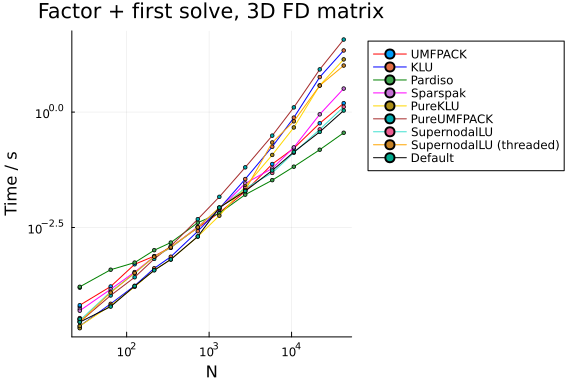
plot_sweep(r3.sizes, r3.tresolve, 3, "Cached re-solve")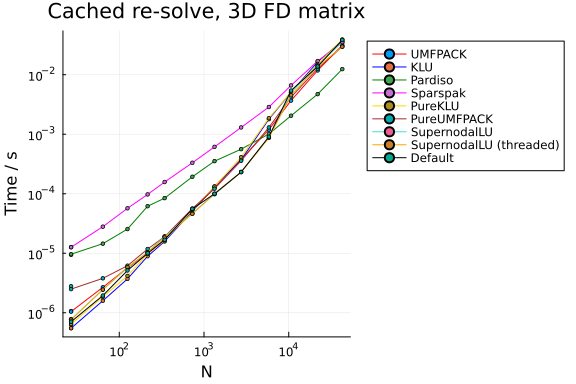
Reading the result
using Printf
# Winner-per-regime table: for each dimension, which algorithm is fastest at the
# largest size, for each phase. A concrete recommendation, not just curves.
println("dim | phase           | fastest at N=max | time (s)")
println("----+-----------------+------------------+---------")
for (dim, r) in ((1, r1), (2, r2), (3, r3))
    for (phase, times) in (("first solve", r.tfirst), ("cached re-solve", r.tresolve))
        row = times[end, :]
        valid = findall(!isnan, row)
        isempty(valid) && continue
        j = valid[argmin(row[valid])]
        @printf("%3d | %-15s | %-16s | %.3g\n", dim, phase, algnames[j], row[j])
    end
end
dim | phase | fastest at N=max | time (s)
----+-----------------+------------------+---------
1 | first solve | PureKLU | 0.007
1 | cached re-solve | PureKLU | 0.000748
2 | first solve | Sparspak | 0.134
2 | cached re-solve | Pardiso | 0.00428
3 | first solve | Pardiso | 0.357
3 | cached re-solve | Pardiso | 0.0124Two things to look for, beyond the raw winner:
- Does the Default line track the best hand-picked method? LinearSolve routes structured-sparse LU problems automatically; if the black line hugs the winner, the automatic choice is doing its job and most users never need to pick by hand.
- First solve vs re-solve can have different winners. A method with expensive analysis but fast backsolves wins workloads that re-solve many times (ODE Jacobians, Newton iterations); a method with cheap factorization wins one-shot solves. This is why the two phases are plotted separately.
What this document does not show: fill-in (factor nnz), peak memory, and non-grid sparsity structures (see the SuiteSparse benchmark in this folder for structure variety). ParU is omitted from this sweep entirely: repeated ParU factorizations within one process ratchet Julia's GC allocation accounting upward irreversibly (its METIS ordering routes every allocation through the counted-malloc path, and GC.gc(true) does not reset the pressure). Once tripped, every allocation-heavy code path in the process slows to a crawl — one sweep run wedged inside a different solver's symbolic analysis purely as collateral damage. Standalone ParU solves are unaffected, and a capped variant (N ≤ 10,240) still poisoned the process for later sizes, so exclusion is the only honest option until the upstream issue is resolved. Found by this benchmark's own runs and reported upstream rather than silently plotted. Matrices here are diagonally dominant FD discretizations — well-conditioned, no pivoting stress; conclusions transfer to problems of similar structure, not to arbitrary sparse matrices.
Appendix
Appendix
These benchmarks are a part of the SciMLBenchmarks.jl repository, found at: https://github.com/SciML/SciMLBenchmarks.jl. For more information on high-performance scientific machine learning, check out the SciML Open Source Software Organization https://sciml.ai.
To locally run this benchmark, do the following commands:
using SciMLBenchmarks
SciMLBenchmarks.weave_file("benchmarks/LinearSolve","SparseDirect.jmd")
Computer Information:
Julia Version 1.12.7
Commit 6d172b025e4 (2026-08-15 08:05 UTC)
Build Info:
  Official https://julialang.org release
Platform Info:
  OS: Linux (x86_64-linux-gnu)
  CPU: 128 × AMD EPYC 7502 32-Core Processor
  WORD_SIZE: 64
  LLVM: libLLVM-18.1.7 (ORCJIT, znver2)
  GC: Built with stock GC
Threads: 128 default, 1 interactive, 128 GC (on 128 virtual cores)
Environment:
  JULIA_NUM_THREADS = auto
Package Information:
Status `/julia/github-runners/amdci1-1/_work/SciMLBenchmarks.jl/SciMLBenchmarks.jl/benchmarks/LinearSolve/Project.toml`
  [6e4b80f9] BenchmarkTools v1.8.0
  [29a986be] FastLapackInterface v2.1.1
⌃ [7ed4a6bd] LinearSolve v5.5.0
  [b51810bb] MatrixDepot v1.1.0
  [46dd5b70] Pardiso v1.1.2
⌃ [91a5bcdd] Plots v1.41.6
⌃ [b7e1f0a2] PureUMFPACK v0.1.4
⌃ [f2c3362d] RecursiveFactorization v0.2.26
⌃ [31c91b34] SciMLBenchmarks v0.1.3 [loaded: v0.1.5]
  [e56a9233] Sparspak v0.3.15
  [10745b16] Statistics v1.11.1
  [3d5dd08c] VectorizationBase v0.21.74
  [856f044c] MKL_jll v2025.2.0+0
⌃ [9e0b026c] ParU_jll v1.0.0+0
  [37e2e46d] LinearAlgebra v1.12.0
  [44cfe95a] Pkg v1.12.1
  [9a3f8284] Random v1.11.0
  [2f01184e] SparseArrays v1.12.0
Info Packages marked with ⌃ have new versions available and may be upgradable.
And the full manifest:
Status `/julia/github-runners/amdci1-1/_work/SciMLBenchmarks.jl/SciMLBenchmarks.jl/benchmarks/LinearSolve/Manifest.toml`
⌃ [47edcb42] ADTypes v1.22.3
  [14f7f29c] AMD v0.5.3
  [7d9f7c33] Accessors v0.1.45
  [79e6a3ab] Adapt v4.7.0
  [66dad0bd] AliasTables v1.1.3
⌃ [4fba245c] ArrayInterface v7.28.1
  [6e4b80f9] BenchmarkTools v1.8.0
  [d1d4a3ce] BitFlags v0.1.10
  [62783981] BitTwiddlingConvenienceFunctions v0.1.6
  [2a0fbf3d] CPUSummary v0.2.7
  [79a69506] ChannelBuffers v0.4.2
  [0b6fb165] ChunkCodecCore v1.0.1
  [4c0bbee4] ChunkCodecLibZlib v1.1.0
  [55437552] ChunkCodecLibZstd v1.0.0
  [fb6a15b2] CloseOpenIntervals v0.1.13
⌃ [944b1d66] CodecZlib v0.7.8
  [35d6a980] ColorSchemes v3.31.0
  [3da002f7] ColorTypes v0.12.1
  [c3611d14] ColorVectorSpace v0.11.0
  [5ae59095] Colors v0.13.1
⌃ [38540f10] CommonSolve v0.2.12
⌃ [f70d9fcc] CommonWorldInvalidations v1.1.1
  [34da2185] Compat v4.18.1
  [a33af91c] CompositionsBase v0.1.2
⌃ [2569d6c7] ConcreteStructs v0.2.6
⌃ [f0e56b4a] ConcurrentUtilities v2.5.1
  [8f4d0f93] Conda v1.10.3
  [187b0558] ConstructionBase v1.6.0
  [d38c429a] Contour v0.6.3
  [adafc99b] CpuId v0.3.1
  [a8cc5b0e] Crayons v4.2.0
  [9a962f9c] DataAPI v1.16.0
  [a93c6f00] DataFrames v1.8.2
  [864edb3b] DataStructures v0.19.6
  [e2d170a0] DataValueInterfaces v1.0.0
  [8bb1440f] DelimitedFiles v1.9.1
  [ffbed154] DocStringExtensions v0.9.5
  [4e289a0a] EnumX v1.0.7
  [460bff9d] ExceptionUnwrapping v0.1.11
  [e2ba6199] ExprTools v0.1.11
  [c87230d0] FFMPEG v0.4.5
  [29a986be] FastLapackInterface v2.1.1
  [5789e2e9] FileIO v1.20.0
  [64ca27bc] FindFirstFunctions v3.2.1
⌅ [53c48c17] FixedPointNumbers v0.8.6
  [1fa38f19] Format v1.3.7
  [069b7b12] FunctionWrappers v1.1.3
⌃ [77dc65aa] FunctionWrappersWrappers v1.12.0
  [46192b85] GPUArraysCore v0.2.0
  [28b8d3ca] GR v0.73.26
  [d7ba0133] Git v1.5.0
  [42e2da0e] Grisu v1.0.2
  [f67ccb44] HDF5 v0.17.3
⌅ [cd3eb016] HTTP v1.11.0
  [076d061b] HashArrayMappedTries v0.2.0
⌅ [eafb193a] Highlights v0.5.3
  [3e5b6fbb] HostCPUFeatures v0.1.18
  [7073ff75] IJulia v1.34.4
  [615f187c] IfElse v0.1.1
  [842dd82b] InlineStrings v1.4.5
  [3587e190] InverseFunctions v0.1.17
  [41ab1584] InvertedIndices v1.3.1
  [92d709cd] IrrationalConstants v0.2.6
  [82899510] IteratorInterfaceExtensions v1.0.0
  [033835bb] JLD2 v0.6.5
  [1019f520] JLFzf v0.1.11
  [692b3bcd] JLLWrappers v1.8.0
⌅ [682c06a0] JSON v0.21.4
⌃ [ba0b0d4f] Krylov v0.10.8
⌃ [b964fa9f] LaTeXStrings v1.4.0
⌃ [23fbe1c1] Latexify v0.16.11
  [10f19ff3] LayoutPointers v0.1.17
⌃ [7ed4a6bd] LinearSolve v5.5.0
  [2ab3a3ac] LogExpFunctions v1.0.1
  [e6f89c97] LoggingExtras v1.2.0
  [bdcacae8] LoopVectorization v0.12.174
  [23992714] MAT v0.12.1
  [3da0fdf6] MPIPreferences v0.1.12
  [1914dd2f] MacroTools v0.5.16
  [d125e4d3] ManualMemory v0.1.8
  [b51810bb] MatrixDepot v1.1.0
  [739be429] MbedTLS v1.1.10
  [442fdcdd] Measures v0.3.3
  [e1d29d7a] Missings v1.2.0
⌃ [46d2c3a1] MuladdMacro v0.2.6
  [ffc61752] Mustache v1.0.21
  [77ba4419] NaNMath v1.1.4
  [6fe1bfb0] OffsetArrays v1.17.0
  [4d8831e6] OpenSSL v1.6.1
⌅ [bac558e1] OrderedCollections v1.8.2
  [46dd5b70] Pardiso v1.1.2
⌃ [69de0a69] Parsers v2.8.6 [loaded: v2.8.7]
  [ccf2f8ad] PlotThemes v3.3.0
  [995b91a9] PlotUtils v1.4.4
⌃ [91a5bcdd] Plots v1.41.6
  [f517fe37] Polyester v0.7.19
  [1d0040c9] PolyesterWeave v0.2.2
  [2dfb63ee] PooledArrays v1.4.3
⌃ [d236fae5] PreallocationTools v1.4.0
  [aea7be01] PrecompileTools v1.3.4
  [21216c6a] Preferences v1.5.2
⌃ [08abe8d2] PrettyTables v3.4.2
  [43287f4e] PtrArrays v1.4.0
⌃ [0c0d3e7f] PureKLU v1.1.1
⌃ [b7e1f0a2] PureUMFPACK v0.1.4
  [3cdcf5f2] RecipesBase v1.3.4
  [01d81517] RecipesPipeline v0.6.12
⌃ [731186ca] RecursiveArrayTools v4.3.5
⌃ [f2c3362d] RecursiveFactorization v0.2.26
  [189a3867] Reexport v1.2.2
  [05181044] RelocatableFolders v1.0.1
  [ae029012] Requires v1.3.1
⌃ [7e49a35a] RuntimeGeneratedFunctions v0.5.22
  [94e857df] SIMDTypes v0.1.0
  [476501e8] SLEEFPirates v0.6.46
⌃ [0bca4576] SciMLBase v3.39.1
⌃ [31c91b34] SciMLBenchmarks v0.1.3 [loaded: v0.1.5]
⌃ [a6db7da4] SciMLLogging v2.0.3
⌃ [c0aeaf25] SciMLOperators v1.25.0
  [431bcebd] SciMLPublic v1.2.4
  [53ae85a6] SciMLStructures v1.10.4
  [7e506255] ScopedValues v1.6.2
  [6c6a2e73] Scratch v1.3.0
  [91c51154] SentinelArrays v1.4.10
  [efcf1570] Setfield v1.1.2
  [992d4aef] Showoff v1.0.3
  [777ac1f9] SimpleBufferStream v1.2.0
  [a2af1166] SortingAlgorithms v1.2.3
⌃ [bd59d7e1] SparseBandedMatrices v1.3.3
⌃ [a57abbd0] SparseColumnPivotedQR v2.1.4
  [e56a9233] Sparspak v0.3.15
  [860ef19b] StableRNGs v1.0.4
⌃ [aedffcd0] Static v1.4.4
  [0d7ed370] StaticArrayInterface v1.10.0
  [1e83bf80] StaticArraysCore v1.4.4
  [10745b16] Statistics v1.11.1
  [82ae8749] StatsAPI v1.8.0
  [2913bbd2] StatsBase v0.34.12
  [7792a7ef] StrideArraysCore v0.5.9
  [69024149] StringEncodings v0.3.7
⌅ [892a3eda] StringManipulation v0.4.6
⌃ [2efcf032] SymbolicIndexingInterface v0.3.51
  [3783bdb8] TableTraits v1.0.1
  [bd369af6] Tables v1.13.0
  [62fd8b95] TensorCore v0.1.1
  [8290d209] ThreadingUtilities v0.5.6
  [3bb67fe8] TranscodingStreams v0.11.3
⌃ [d5829a12] TriangularSolve v0.2.1
⌃ [5c2747f8] URIs v1.6.1
  [3a884ed6] UnPack v1.0.2
  [1cfade01] UnicodeFun v0.4.1
  [41fe7b60] Unzip v0.2.0
  [3d5dd08c] VectorizationBase v0.21.74
  [33b4df10] VectorizedRNG v0.2.26
  [81def892] VersionParsing v1.3.0
  [44d3d7a6] Weave v0.10.12
  [ddb6d928] YAML v0.4.16
  [c2297ded] ZMQ v1.5.1
  [6e34b625] Bzip2_jll v1.0.9+0
  [83423d85] Cairo_jll v1.18.7+0
  [ee1fde0b] Dbus_jll v1.16.2+0
  [2702e6a9] EpollShim_jll v0.0.20230411+1
⌃ [2e619515] Expat_jll v2.8.2+0
⌅ [b22a6f82] FFMPEG_jll v8.1.2+0
  [a3f928ae] Fontconfig_jll v2.17.1+0
  [d7e528f0] FreeType2_jll v2.14.3+1
  [559328eb] FriBidi_jll v1.0.17+0
  [0656b61e] GLFW_jll v3.4.1+1
  [d2c73de3] GR_jll v0.73.26+0
⌅ [b0724c58] GettextRuntime_jll v0.22.4+0
  [61579ee1] Ghostscript_jll v9.55.1+0
  [020c3dae] Git_LFS_jll v3.7.1+0
⌃ [f8c6e375] Git_jll v2.54.0+0
⌃ [7746bdde] Glib_jll v2.86.3+0
  [3b182d85] Graphite2_jll v1.3.16+0
⌅ [0234f1f7] HDF5_jll v2.1.2+0
⌅ [2e76f6c2] HarfBuzz_jll v8.5.1+0
  [e33a78d0] Hwloc_jll v2.14.0+0
  [1d5cc7b8] IntelOpenMP_jll v2025.2.0+0
⌃ [aacddb02] JpegTurbo_jll v3.2.0+0
  [c1c5ebd0] LAME_jll v3.100.3+0
  [88015f11] LERC_jll v4.1.0+0
  [1d63c593] LLVMOpenMP_jll v22.1.7+0
⌅ [e9f186c6] Libffi_jll v3.4.7+0
  [7e76a0d4] Libglvnd_jll v1.7.1+1
  [94ce4f54] Libiconv_jll v1.18.0+0
  [4b2f31a3] Libmount_jll v2.42.0+0
  [89763e89] Libtiff_jll v4.7.3+0
  [38a345b3] Libuuid_jll v2.42.0+0
  [856f044c] MKL_jll v2025.2.0+0
⌅ [b5ada748] MPIABI_jll v0.1.5+0
  [7cb0a576] MPICH_jll v5.0.1+0
  [f1f71cc9] MPItrampoline_jll v5.5.6+0
  [c8ffd9c3] MbedTLS_jll v2.28.1010+0
  [9237b28f] MicrosoftMPI_jll v10.1.4+3
  [e7412a2a] Ogg_jll v1.3.6+0
  [fe0851c0] OpenMPI_jll v5.0.11+0
⌃ [9bd350c2] OpenSSH_jll v10.4.1+0
  [91d4177d] Opus_jll v1.6.1+0
⌃ [36c8627f] Pango_jll v1.57.1+0
⌃ [9e0b026c] ParU_jll v1.0.0+0
  [30392449] Pixman_jll v0.46.4+0
  [c0090381] Qt6Base_jll v6.10.2+2
  [629bc702] Qt6Declarative_jll v6.10.2+2
  [ce943373] Qt6ShaderTools_jll v6.10.2+1
  [6de9746b] Qt6Svg_jll v6.10.2+0
  [e99dba38] Qt6Wayland_jll v6.10.2+1
  [a44049a8] Vulkan_Loader_jll v1.3.243+0
  [a2964d1f] Wayland_jll v1.24.0+0
⌅ [02c8fc9c] XML2_jll v2.13.9+0
  [ffd25f8a] XZ_jll v5.8.3+0
  [f67eecfb] Xorg_libICE_jll v1.1.2+0
  [c834827a] Xorg_libSM_jll v1.2.6+0
  [4f6342f7] Xorg_libX11_jll v1.8.13+0
  [0c0b7dd1] Xorg_libXau_jll v1.0.13+0
  [935fb764] Xorg_libXcursor_jll v1.2.4+0
  [a3789734] Xorg_libXdmcp_jll v1.1.6+0
  [1082639a] Xorg_libXext_jll v1.3.8+0
  [d091e8ba] Xorg_libXfixes_jll v6.0.2+0
⌃ [a51aa0fd] Xorg_libXi_jll v1.8.3+0
  [d1454406] Xorg_libXinerama_jll v1.1.7+0
  [ec84b674] Xorg_libXrandr_jll v1.5.6+0
  [ea2f1a96] Xorg_libXrender_jll v0.9.12+0
  [a65dc6b1] Xorg_libpciaccess_jll v0.19.0+0
  [c7cfdc94] Xorg_libxcb_jll v1.17.1+0
  [cc61e674] Xorg_libxkbfile_jll v1.2.0+0
  [e920d4aa] Xorg_xcb_util_cursor_jll v0.1.6+0
  [12413925] Xorg_xcb_util_image_jll v0.4.1+0
  [2def613f] Xorg_xcb_util_jll v0.4.1+0
  [975044d2] Xorg_xcb_util_keysyms_jll v0.4.1+0
  [0d47668e] Xorg_xcb_util_renderutil_jll v0.3.10+0
  [c22f9ab0] Xorg_xcb_util_wm_jll v0.4.2+0
  [35661453] Xorg_xkbcomp_jll v1.4.7+0
  [33bec58e] Xorg_xkeyboard_config_jll v2.47.0+2
  [c5fb5394] Xorg_xtrans_jll v1.6.0+0
  [8f1865be] ZeroMQ_jll v4.3.6+0
  [3161d3a3] Zstd_jll v1.5.7+1
⌅ [2b3700d1] aws_c_auth_jll v0.9.6+0
  [70f11efc] aws_c_cal_jll v0.9.13+0
  [73048d1d] aws_c_common_jll v0.12.6+0
  [73a04cd5] aws_c_compression_jll v0.3.2+0
  [3254fc65] aws_c_http_jll v0.10.13+0
  [13c41daa] aws_c_io_jll v0.26.3+0
⌅ [bd1f34fb] aws_c_s3_jll v0.11.5+0
  [1282aa60] aws_c_sdkutils_jll v0.2.4+1
  [b2a88e68] aws_checksums_jll v0.2.10+0
  [c4b69c83] dlfcn_win32_jll v1.4.2+0
  [35ca27e7] eudev_jll v3.2.14+0
⌅ [214eeab7] fzf_jll v0.61.1+0
  [477f73a3] libaec_jll v1.1.7+0
⌃ [a4ae2306] libaom_jll v3.13.3+0
  [0ac62f75] libass_jll v0.17.4+0
  [1183f4f0] libdecor_jll v0.2.2+0
  [8e53e030] libdrm_jll v2.4.134+0
  [2db6ffa8] libevdev_jll v1.13.4+0
  [f638f0a6] libfdk_aac_jll v2.0.4+0
  [36db933b] libinput_jll v1.28.1+0
  [b53b4c65] libpng_jll v1.6.58+0
  [a9144af2] libsodium_jll v1.0.21+0
  [9a156e7d] libva_jll v2.23.0+0
  [f27f6e37] libvorbis_jll v1.3.8+0
⌅ [9aeb927a] mpif_jll v0.1.7+0
  [009596ad] mtdev_jll v1.1.7+0
  [1317d2d5] oneTBB_jll v2022.3.0+0
  [cddc5d3d] s2n_tls_jll v1.7.3+0
⌅ [1270edf5] x264_jll v10164.0.1+0
  [dfaa095f] x265_jll v4.1.0+0
  [d8fb68d0] xkbcommon_jll v1.13.0+0
  [0dad84c5] ArgTools v1.1.2
  [56f22d72] Artifacts v1.11.0
  [2a0f44e3] Base64 v1.11.0
  [ade2ca70] Dates v1.11.0
  [8ba89e20] Distributed v1.11.0
  [f43a241f] Downloads v1.7.0
  [7b1f6079] FileWatching v1.11.0
  [9fa8497b] Future v1.11.0
  [b77e0a4c] InteractiveUtils v1.11.0
  [ac6e5ff7] JuliaSyntaxHighlighting v1.12.0
  [4af54fe1] LazyArtifacts v1.11.0
  [b27032c2] LibCURL v0.6.4
  [76f85450] LibGit2 v1.11.0
  [8f399da3] Libdl v1.11.0
  [37e2e46d] LinearAlgebra v1.12.0
  [56ddb016] Logging v1.11.0
  [d6f4376e] Markdown v1.11.0
  [a63ad114] Mmap v1.11.0
  [ca575930] NetworkOptions v1.3.0
  [44cfe95a] Pkg v1.12.1
  [de0858da] Printf v1.11.0
  [9abbd945] Profile v1.11.0
  [3fa0cd96] REPL v1.11.0
  [9a3f8284] Random v1.11.0
  [ea8e919c] SHA v0.7.0
  [9e88b42a] Serialization v1.11.0
  [6462fe0b] Sockets v1.11.0
  [2f01184e] SparseArrays v1.12.0
  [f489334b] StyledStrings v1.11.0
  [fa267f1f] TOML v1.0.3
  [a4e569a6] Tar v1.10.0
  [8dfed614] Test v1.11.0
  [cf7118a7] UUIDs v1.11.0
  [4ec0a83e] Unicode v1.11.0
  [e66e0078] CompilerSupportLibraries_jll v1.3.0+1
  [deac9b47] LibCURL_jll v8.15.0+0
  [e37daf67] LibGit2_jll v1.9.0+0
  [29816b5a] LibSSH2_jll v1.11.3+1
  [14a3606d] MozillaCACerts_jll v2025.11.4
  [4536629a] OpenBLAS_jll v0.3.29+0
  [05823500] OpenLibm_jll v0.8.7+0
  [458c3c95] OpenSSL_jll v3.5.4+0
  [efcefdf7] PCRE2_jll v10.44.0+1
  [bea87d4a] SuiteSparse_jll v7.8.3+2
  [83775a58] Zlib_jll v1.3.1+2
  [8e850b90] libblastrampoline_jll v5.15.0+0
  [8e850ede] nghttp2_jll v1.64.0+1
  [3f19e933] p7zip_jll v17.7.0+0
Info Packages marked with ⌃ and ⌅ have new versions available. Those with ⌃ may be upgradable, but those with ⌅ are restricted by compatibility constraints from upgrading. To see why use `status --outdated -m`