Kuramoto-Sivashinsky Finite-Difference Method Work-Precision Diagrams
Problem Description
The Kuramoto-Sivashinsky partial differential equation is solved on the domain $[-L, L] \times [0, T] \in \mathbb R \times R,~L = 16,~T = 30$, with the following initial and periodic boundary conditions:
\[\begin{align} \partial_t u & = -\kappa u(t,x)\partial_x u(t,x) - \beta \partial_x^2 u(t,x) - \gamma \partial_x^4 u(t,x), \\ u(0,x) & = \cos\left(\frac{2\pi}{L} x\right), \\ u(t,-L) & = u(t,L) = 1. \end{align}\]
The spatial derivative operators are represented via finite difference approximations, incorporating the periodic boundary conditions on an equispaced grid of points $x_s \in [-L, L]$. The coefficients $\kappa = 1,~\beta = 1/2,~\gamma = 1/8$ are chosen to produce `interesting' behavior as seen in the reference solution below.
\[\begin{align} \frac{du}{dt} & = -\kappa u D_x u - \beta D_x^2 u - \gamma D_x^4 u, \\ u(0,x_s) & = \cos\left(\frac{2\pi}{L} x_s\right), \\ u(t,-L) & = u(t,L) = 1. \end{align}\]
Implementation
using OrdinaryDiffEq
using OrdinaryDiffEqBDF, OrdinaryDiffEqExponentialRK, OrdinaryDiffEqFIRK, OrdinaryDiffEqIMEXMultistep, OrdinaryDiffEqMultirate, OrdinaryDiffEqRosenbrock, OrdinaryDiffEqSDIRK, OrdinaryDiffEqStabilizedRK
using ADTypes: AutoFiniteDiff
using DiffEqDevTools
using SciMLOperators
using LinearSolve
using LinearAlgebra
using SparseArrays
using Sundials
using SummationByPartsOperators
const SBP = SummationByPartsOperators
using Plots
gr();
nonlinear_convection!(du, u, p, t) = du .= (-p.alpha / 3) * (u .* (p.D1 * u) + p.D1 * (u .^ 2))
# Construct the problem
function kuramoto_sivashinsky(N, L, alpha)
D1 = periodic_derivative_operator(derivative_order = 1, accuracy_order = 4,
xmin = -L, xmax = L, N = N)
D2 = periodic_derivative_operator(derivative_order = 2, accuracy_order = 4,
xmin = -L, xmax = L, N = N)
D4 = periodic_derivative_operator(derivative_order = 4, accuracy_order = 4,
xmin = -L, xmax = L, N = N)
x = SBP.grid(D1)
u0 = @. cos(2π * x / L) # Initial condition
p = (; D1, alpha)
tspan = (0.0, 1.0)
prob = SplitODEProblem(MatrixOperator(-p.alpha / 2 * (sparse(D2) + 1/4 * sparse(D4))),
nonlinear_convection!,
u0, tspan, p);
return x, prob
end;Reference Solution
Using an adaptive timestepping method to solve the system of ordinary differential equations with high precision.
N = 128  # Number of grid points
L = 16.0  # Domain length
alpha = 30.0 # Time scaling factor
xs, prob = kuramoto_sivashinsky(N, L, alpha)
@time sol = solve(prob, RadauIIA5(autodiff=AutoFiniteDiff()); dt = 1e-4, abstol=1e-14, reltol=1e-14, adaptive=true)

test_sol = TestSolution(sol);

tslices = LinRange(prob.tspan..., 50)
ys = mapreduce(sol, hcat, tslices)
plt = heatmap(xs, tslices, ys', xlabel="x", ylabel="t")
18.720262 seconds (17.88 M allocations: 1.273 GiB, 4.53% gc time, 62.16% c
ompilation time)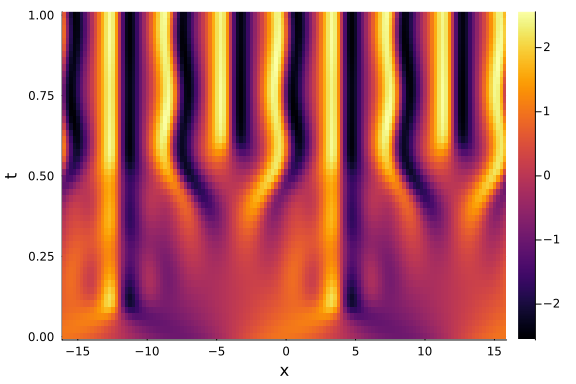
Work-Precision Diagrams
High Tolerances
Implicit-Explicit Methods
abstols = 0.1 .^ (3:6) # all fixed dt methods so these don't matter much
reltols = 0.1 .^ (3:6)
multipliers = 0.3 .^ (0:3)
setups = [
    Dict(:alg => IMEXEuler(), :dts => 1e-4 * multipliers),
    Dict(:alg => CNAB2(), :dts => 1e-3 * multipliers),
    Dict(:alg => CNLF2(), :dts => 1e-3 * multipliers),
    Dict(:alg => SBDF2(), :dts => 1e-3 * multipliers),
]
labels = hcat(
    "IMEXEuler",
    "CNAB2",
    "CNLF2",
    "SBDF2",
)
@time wp = WorkPrecisionSet(prob, abstols, reltols, setups;
    print_names=true, names=labels, numruns=5, error_estimate=:l2,
    save_everystep=false, appxsol=test_sol, maxiters=Int(1e6));

plot(wp, label=labels, markershape=:auto, title="IMEX Methods, High Tolerance")
IMEXEuler
CNAB2
CNLF2
SBDF2
112.700337 seconds (52.84 M allocations: 19.432 GiB, 9.52% gc time, 22.28%
compilation time)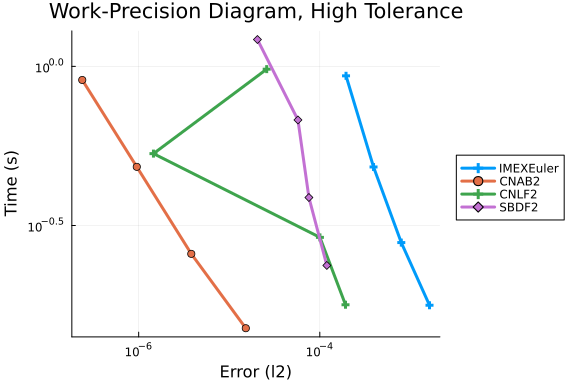
Exponential Integrators
abstols = 0.1 .^ (3:6) # all fixed dt methods so these don't matter much
reltols = 0.1 .^ (3:6)
multipliers = 0.3 .^ (0:3)
setups = [
    Dict(:alg => NorsettEuler(), :dts => 1e-4 * multipliers),
    Dict(:alg => NorsettEuler(krylov=true, m=5), :dts => 1e-4 * multipliers),
    Dict(:alg => NorsettEuler(krylov=true, m=20), :dts => 1e-4 * multipliers),
    Dict(:alg => ETDRK2(), :dts => 1e-3 * multipliers),
    Dict(:alg => ETDRK2(krylov=true, m=5), :dts => 1e-3 * multipliers),
    Dict(:alg => ETDRK2(krylov=true, m=20), :dts => 1e-3 * multipliers)
]
labels = hcat(
    "NorsettEuler (caching)",
    "NorsettEuler (m=5)",
    "NorsettEuler (m=20)",
    "ETDRK2 (caching)",
    "ETDRK2 (m=5)",
    "ETDRK2 (m=20)"
)
@time wp = WorkPrecisionSet(prob, abstols, reltols, setups;
    print_names=true, names=labels, numruns=5, error_estimate=:l2,
    save_everystep=false, appxsol=test_sol, maxiters=Int(1e6));

plot(wp, label=labels, markershape=:auto, title="ExpRK Methods, High Tolerance")
NorsettEuler (caching)
NorsettEuler (m=5)
NorsettEuler (m=20)
ETDRK2 (caching)
ETDRK2 (m=5)
ETDRK2 (m=20)
283.458314 seconds (143.72 M allocations: 72.343 GiB, 10.14% gc time, 6.00%
compilation time)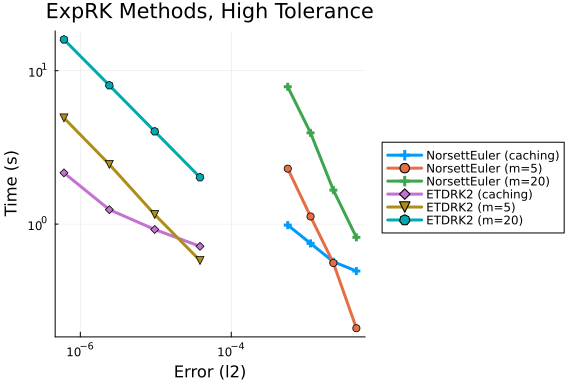
Stabilized Integrators
abstols = 0.1 .^ (3:6)
reltols = 0.1 .^ (3:6)

setups = [
    Dict(:alg => ROCK4()),
    Dict(:alg => TSRKC3()),
    Dict(:alg => RKC()),
    Dict(:alg => ROCK2()),
]
labels = hcat(
    "ROCK4",
    "TSRKC3",
    "RKC",
    "ROCK2",
)
@time wp = WorkPrecisionSet(prob, abstols, reltols, setups;
    print_names=true, names=labels, numruns=5, error_estimate=:l2,
    save_everystep=false, appxsol=test_sol, maxiters=Int(1e5));

plot(wp, label=labels, markershape=:auto, title="Stabilized Methods, High Tolerance")
ROCK4
TSRKC3
RKC
ROCK2
18.912960 seconds (14.07 M allocations: 3.766 GiB, 9.48% gc time, 80.49% c
ompilation time)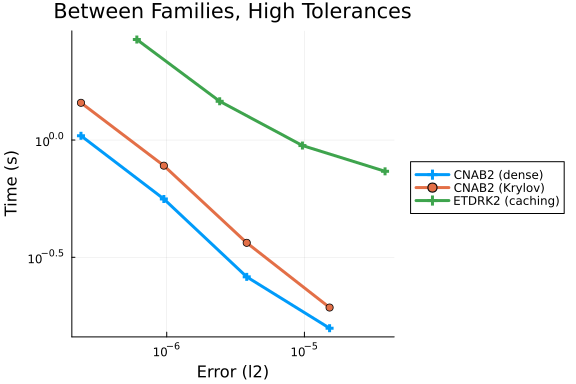
Multirate Methods
The methods from OrdinaryDiffEqMultirate.jl consume the same SplitODEProblem: the first component (the linear term containing the fourth derivative operator) is advanced with m explicit substeps inside every macro step, while the nonlinear convection is evaluated only at the macro rate. Multirate integration is built for problems whose slow component is expensive per evaluation. Here the slow component costs two sparse matrix-vector products, no more than the fast one, so the substeps buy stability on a genuinely stiff operator without saving any slow work, and the comparison against CNAB2 and ETDRK2 measures what that costs relative to treating the stiff term implicitly or exactly.
The linear operator has spectral radius about 1.4e4. With macro steps up to 2e-3, the choice m = 32 puts the largest micro step at 2e-3 * 1.4e4 / 32, about 0.9, inside the explicit micro stability bound of 2 with a factor of two margin. A scan from m = 32 to m = 128 left every error essentially unchanged, so the macro error dominates and larger m is pure cost. The methods are run at fixed macro steps, matching the other fixed step methods in this file.
For cross family context the same five reference methods appear in every multirate figure of this folder: adaptive Tsit5, Rodas5P, and FBDF on the joined right hand side (FBDF cannot consume the split form), KenCarp4 on the split problem, and fixed step ETDRK4 at the step sizes this file uses for it elsewhere. On this problem KenCarp4 gets the Krylov linear solver: its dense default spends minutes per solve even at loose tolerances here, the same cost problem the implicit block below documents. The adaptive sweep runs at 1e-4 to 1e-7 rather than this file's usual 1e-3 start because the Krylov KenCarp4 solve stalls into a singular factorization at 1e-3 on this problem; the fixed step methods are unaffected by the tolerance values.
abstols = 0.1 .^ (4:7) # all fixed dt methods so these don't matter much
reltols = 0.1 .^ (4:7)
multipliers = 0.5 .^ (0:3)
# The joined problem calls f1 and f2 through its own buffer: a direct call of the
# SplitFunction uses an internal scratch cache that aliases prob.u0, so it would
# silently overwrite the initial condition of every later solve in the sweep.
joined_rhs! = let stiff_cache = zero(prob.u0)
    (du, u, p, t) -> begin
        prob.f.f1(stiff_cache, u, p, t)
        prob.f.f2(du, u, p, t)
        du .+= stiff_cache
    end
end
prob_joined = ODEProblem(joined_rhs!, copy(prob.u0), prob.tspan, prob.p)
setups = [
    Dict(:alg => MREEF(m = 32, order = 4), :adaptive => false, :dts => 2e-3 * multipliers),
    Dict(:alg => MRAB(k = 2, m = 32), :adaptive => false, :dts => 2e-3 * multipliers),
    Dict(:alg => MIS(m = 32), :adaptive => false, :dts => 2e-3 * multipliers),
    Dict(:alg => MRIGARKERK22a(m = 32), :adaptive => false, :dts => 2e-3 * multipliers),
    Dict(:alg => MRIGARKERK33a(m = 32), :adaptive => false, :dts => 2e-3 * multipliers),
    Dict(:alg => MRIGARKERK45a(m = 32), :adaptive => false, :dts => 2e-3 * multipliers),
    Dict(:alg => CNAB2(), :dts => 1e-3 * multipliers),
    Dict(:alg => ETDRK2(), :dts => 1e-3 * multipliers),
    Dict(:alg => ETDRK4(), :dts => 1e-3 * multipliers),
    Dict(:alg => KenCarp4(linsolve = KrylovJL_GMRES())),
    Dict(:alg => Tsit5(), :prob_choice => 2),
    Dict(:alg => Rodas5P(autodiff = AutoFiniteDiff()), :prob_choice => 2),
    Dict(:alg => FBDF(autodiff = AutoFiniteDiff()), :prob_choice => 2),
    Dict(:alg => NordsieckBDF(autodiff = AutoFiniteDiff()), :prob_choice => 2),
]
labels = hcat(
    "MREEF",
    "MRAB",
    "MIS",
    "MRIGARKERK22a",
    "MRIGARKERK33a",
    "MRIGARKERK45a",
    "CNAB2",
    "ETDRK2",
    "ETDRK4",
    "KenCarp4 (Krylov)",
    "Tsit5",
    "Rodas5P",
    "FBDF","NordsieckBDF",
)
@time wp = WorkPrecisionSet([prob, prob_joined], abstols, reltols, setups;
    print_names=true, names=labels, numruns=5, error_estimate=:l2,
    save_everystep=false, appxsol=[test_sol, test_sol], maxiters=Int(1e6));

plot(wp, label=labels, markershape=:auto, title="Multirate Methods, High Tolerance")
MREEF
MRAB
MIS
MRIGARKERK22a
MRIGARKERK33a
MRIGARKERK45a
CNAB2
ETDRK2
ETDRK4
KenCarp4 (Krylov)
Tsit5
Rodas5P
FBDF
NordsieckBDF
194.814828 seconds (79.26 M allocations: 38.623 GiB, 6.27% gc time, 27.00%
compilation time)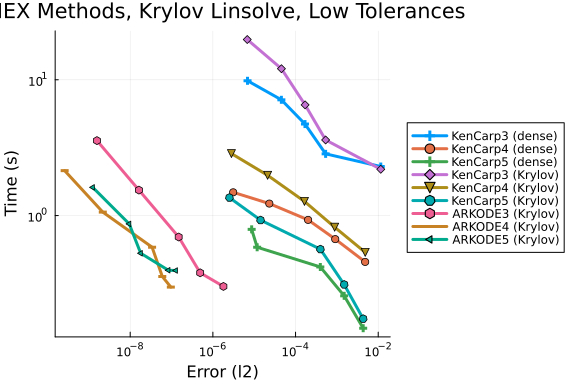
The measured curves make this a much harder problem for the explicit multirate members than Burgers, and the cross family references decide it. FBDF dominates the figure outright: 7 to 9 milliseconds per solve across the whole sweep with errors from 6e-4 down to 1.4e-7, one to two orders of magnitude cheaper than any other method at matched error. Tsit5 on the joined problem runs at a stability capped, nearly constant 0.07 seconds while its error falls from 6e-6 to 1.1e-8 for free, and Rodas5P reaches 7.9e-8 in 0.16 seconds. Against that, the explicit multirate members are not competitive: MREEF needs 0.78 seconds for 1.1e-8, eleven times Tsit5's cost at the same error, and every decade carries the m = 32 micro stepping tax. Within the fixed step family the old reading still holds (MRIGARKERK33a and CNAB2 tie near 1e-4, the multirate members extend below the references' 2.4e-5 floor), MRAB is unusable here since the convection it freezes is not slow, and MRIGARKERK45a loses order at the loose end. With both components equally cheap there is nothing for the multirate structure to amortize; what these curves document is that the explicit members hold stability and order on a strongly stiff fast operator, and that adaptive single rate stiff solvers own this problem.
The implicit multirate members treat the slow component implicitly, so for them the split is used in the reverse orientation: the stiff linear term becomes the implicitly handled slow part and the nonlinear convection is micro stepped explicitly. In this orientation the methods act as IMEX integrators whose explicit part is subdivided m times per stage; the convection is not fast, the substeps resolve nothing, and m = 2 is kept at the smallest useful value. KenCarp3 and KenCarp4 on the original problem make the same implicit and explicit assignment of the two terms, which makes them the natural single rate references; they are given the Krylov linear solver here because their dense default costs minutes per solve on this problem at the tighter tolerances, as the low tolerance section below also shows. The cross family references from the figure above run here as well over this tolerance range. These methods are adaptive apart from ETDRK4, which keeps its fixed step convention.
Astiff = convert(AbstractMatrix, prob.f.f1.f)
p_stiff = (; D1 = prob.p.D1, alpha = prob.p.alpha, A = Astiff)
stiff_linear!(du, u, p, t) = mul!(du, p.A, u)
prob_swapped = SplitODEProblem(nonlinear_convection!, stiff_linear!,
                               prob.u0, prob.tspan, p_stiff)

abstols = 0.1 .^ (4:8)
reltols = 0.1 .^ (4:8)
setups = [
    Dict(:alg => MRIGARKIRK21a(m = 2, autodiff = AutoFiniteDiff())),
    Dict(:alg => MRIGARKESDIRK34a(m = 2, autodiff = AutoFiniteDiff())),
    Dict(:alg => MRIGARKESDIRK46a(m = 2, autodiff = AutoFiniteDiff())),
    Dict(:alg => KenCarp3(linsolve = KrylovJL_GMRES()), :prob_choice => 2),
    Dict(:alg => KenCarp4(linsolve = KrylovJL_GMRES()), :prob_choice => 2),
    Dict(:alg => ETDRK4(), :prob_choice => 2, :dts => 1e-3 * 0.5 .^ (0:4)),
    Dict(:alg => Tsit5(), :prob_choice => 3),
    Dict(:alg => Rodas5P(autodiff = AutoFiniteDiff()), :prob_choice => 3),
    Dict(:alg => FBDF(autodiff = AutoFiniteDiff()), :prob_choice => 3),
    Dict(:alg => NordsieckBDF(autodiff = AutoFiniteDiff()), :prob_choice => 3),
]
labels = hcat(
    "MRIGARKIRK21a",
    "MRIGARKESDIRK34a",
    "MRIGARKESDIRK46a",
    "KenCarp3 (Krylov)",
    "KenCarp4 (Krylov)",
    "ETDRK4",
    "Tsit5",
    "Rodas5P",
    "FBDF","NordsieckBDF",
)
@time wp = WorkPrecisionSet([prob_swapped, prob, prob_joined], abstols, reltols, setups;
    print_names=true, names=labels, numruns=5, error_estimate=:l2,
    save_everystep=false, appxsol=[test_sol, test_sol, test_sol], maxiters=Int(1e6));

plot(wp, label=labels, markershape=:auto, title="Implicit Multirate Methods")
MRIGARKIRK21a
MRIGARKESDIRK34a
MRIGARKESDIRK46a
KenCarp3 (Krylov)
KenCarp4 (Krylov)
ETDRK4
Tsit5
Rodas5P
FBDF
NordsieckBDF
233.768166 seconds (160.31 M allocations: 135.435 GiB, 25.31% gc time, 11.5
4% compilation time)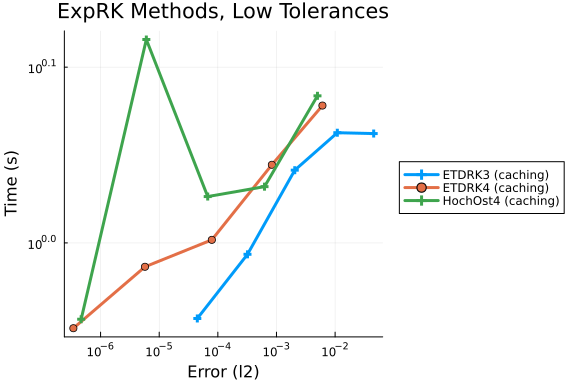
Within the split constrained comparison the reversed orientation works: MRIGARKIRK21a and MRIGARKESDIRK34a run clean order lines (the second order member from 3.8e-4 in 24 milliseconds to 3.1e-8 in 2.6 seconds, the third order member to 6.1e-10 at about 10 seconds), and against the KenCarp references making the same term assignment they come out 30 to 300 times faster at matched error, for example MRIGARKESDIRK34a at 3.3e-5 in 0.11 seconds against KenCarp4 at 4.4e-5 in 2.3 seconds. MRIGARKESDIRK46a is the cheapest member at mid accuracies (1.8e-6 in a quarter of a second) but its error stops responding at the tightest pairs, rising back toward 1e-6, so its tolerance is not a trustworthy control knob at that end. The cross family references cap the claim, though: FBDF on the joined problem reaches 1.2e-7 in under 15 milliseconds and Tsit5 reaches 9.3e-10 in 0.074 seconds, so at matched error the free choice single rate methods beat the best multirate member by one to two orders of magnitude. The reading these curves support is narrow: among methods constrained to treat this split implicitly and explicitly by term, the solve decoupled members are much cheaper than the IMEX family in this range; once that constraint is dropped, an adaptive BDF or a stability capped explicit method solves the problem faster than any of them.
Comparisons Between Families
abstols = 0.1 .^ (3:6)
reltols = 0.1 .^ (3:6)
multipliers = 0.3 .^ (0:3)
setups = [
    Dict(:alg => CNAB2(), :dts => 1e-3 * multipliers),
    Dict(:alg => CNAB2(linsolve=KrylovJL_GMRES()), :dts => 1e-3 * multipliers),
    Dict(:alg => ETDRK2(), :dts => 1e-3 * multipliers),
    Dict(:alg => ROCK4()),
    Dict(:alg => TSRKC3()),
]
labels = hcat(
    "CNAB2 (dense)",
    "CNAB2 (Krylov)",
    "ETDRK2 (caching)",
    "ROCK4",
    "TSRKC3",
)
@time wp = WorkPrecisionSet(prob, abstols, reltols, setups;
    print_names=true, names=labels, numruns=5, error_estimate=:l2,
    save_everystep=false, appxsol=test_sol, maxiters=Int(1e5));

plot(wp, label=labels, markershape=:auto, title="Between Families, High Tolerances")
CNAB2 (dense)
CNAB2 (Krylov)
ETDRK2 (caching)
ROCK4
TSRKC3
66.092021 seconds (17.21 M allocations: 17.985 GiB, 11.02% gc time, 4.21%
compilation time)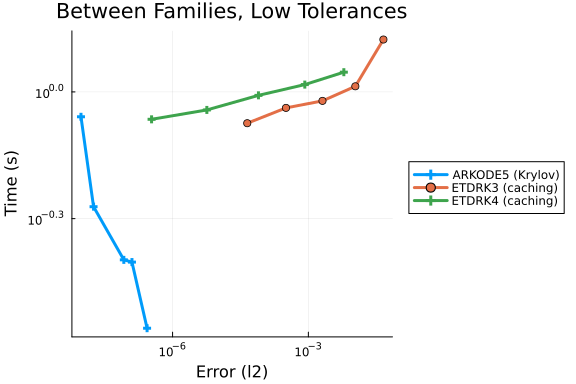
Low Tolerances
Implicit-Explicit Methods
Default and explicit Krylov linear solvers.
abstols = 0.1 .^ (7:11)
reltols = 0.1 .^ (7:11)
setups = [
    Dict(:alg => KenCarp3()),
    Dict(:alg => KenCarp4()),
    Dict(:alg => KenCarp5()),
    Dict(:alg => KenCarp3(linsolve=KrylovJL_GMRES())),
    Dict(:alg => KenCarp4(linsolve=KrylovJL_GMRES())),
    Dict(:alg => KenCarp5(linsolve=KrylovJL_GMRES())),
    Dict(:alg => ARKODE(Sundials.Implicit(), order=3, linear_solver=:GMRES)),
    Dict(:alg => ARKODE(Sundials.Implicit(), order=4, linear_solver=:GMRES)),
    Dict(:alg => ARKODE(Sundials.Implicit(), order=5, linear_solver=:GMRES)),
]
labels = hcat(
    "KenCarp3 (default)",
    "KenCarp4 (default)",
    "KenCarp5 (default)",
    "KenCarp3 (Krylov)",
    "KenCarp4 (Krylov)",
    "KenCarp5 (Krylov)",
    "ARKODE3 (Krylov)",
    "ARKODE4 (Krylov)",
    "ARKODE5 (Krylov)",
)
@time wp = WorkPrecisionSet(prob, abstols, reltols, setups;
    print_names=true, names=labels, numruns=5, error_estimate=:l2,
    save_everystep=false, appxsol=test_sol, maxiters=Int(1e5));

plot(wp, label=labels, markershape=:auto, title="IMEX Methods, Low Tolerances")
KenCarp3 (default)
KenCarp4 (default)
KenCarp5 (default)
KenCarp3 (Krylov)
KenCarp4 (Krylov)
KenCarp5 (Krylov)
ARKODE3 (Krylov)
ARKODE4 (Krylov)
ARKODE5 (Krylov)
325.392564 seconds (253.19 M allocations: 46.132 GiB, 7.30% gc time, 16.30%
compilation time)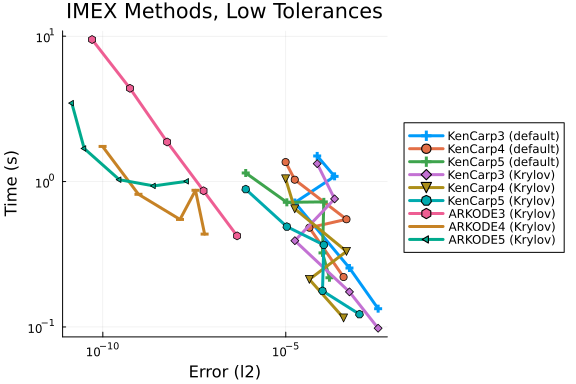
Exponential Integrators
abstols = 0.1 .^ (7:11) # all fixed dt methods so these don't matter much
reltols = 0.1 .^ (4:8)
multipliers = 0.5 .^ (0:4)
setups = [
    Dict(:alg => ETDRK3(), :dts => 1e-4 * multipliers),
    Dict(:alg => ETDRK4(), :dts => 1e-3 * multipliers),
    Dict(:alg => HochOst4(), :dts => 1e-3 * multipliers),
]
labels = hcat(
    "ETDRK3 (caching)",
    "ETDRK4 (caching)",
    "HochOst4 (caching)",
)
@time wp = WorkPrecisionSet(prob, abstols, reltols, setups;
    print_names=true, names=labels, numruns=5, error_estimate=:l2,
    save_everystep=false, appxsol=test_sol, maxiters=Int(1e6));

plot(wp, label=labels, markershape=:auto, title="ExpRK Methods, Low Tolerances")
ETDRK3 (caching)
ETDRK4 (caching)
HochOst4 (caching)
168.070463 seconds (34.78 M allocations: 54.655 GiB, 9.07% gc time, 3.88% c
ompilation time)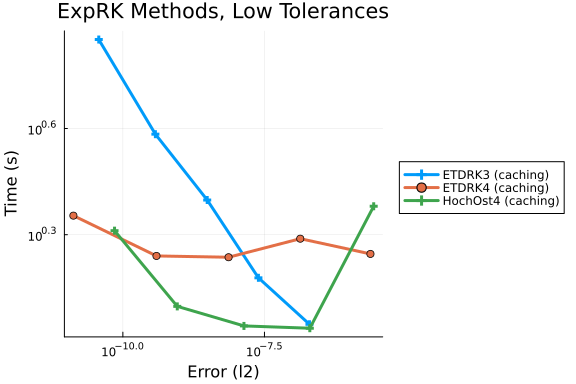
Comparisons Between Families
abstols = 0.1 .^ (7:11)
reltols = 0.1 .^ (4:8)
multipliers = 0.5 .^ (0:4)
setups = [
    Dict(:alg => ARKODE(Sundials.Implicit(), order=5, linear_solver=:GMRES)),
    Dict(:alg => ETDRK3(), :dts => 1e-4 * multipliers),
    Dict(:alg => ETDRK4(), :dts => 1e-3 * multipliers),
    Dict(:alg => ROCK4()),
    Dict(:alg => TSRKC3()),
]
labels = hcat(
    "ARKODE5 (Krylov)",
    "ETDRK3 (caching)",
    "ETDRK4 (caching)",
    "ROCK4",
    "TSRKC3",
)
@time wp = WorkPrecisionSet(prob, abstols, reltols, setups;
    print_names=true, names=labels, numruns=5, error_estimate=:l2,
    save_everystep=false, appxsol=test_sol, maxiters=Int(1e6));

plot(wp, label=labels, markershape=:auto, title="Between Families, Low Tolerances")
ARKODE5 (Krylov)
ETDRK3 (caching)
ETDRK4 (caching)
ROCK4
TSRKC3
154.389894 seconds (77.11 M allocations: 54.057 GiB, 12.98% gc time)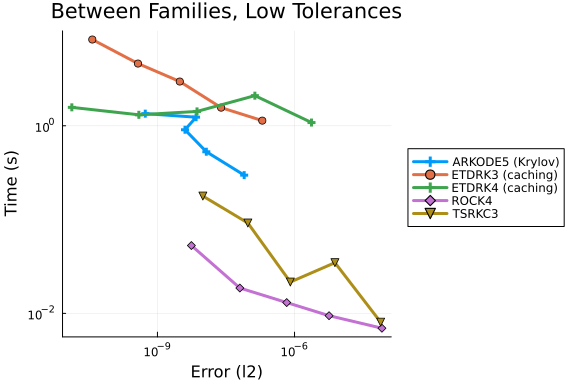
Appendix
These benchmarks are a part of the SciMLBenchmarks.jl repository, found at: https://github.com/SciML/SciMLBenchmarks.jl. For more information on high-performance scientific machine learning, check out the SciML Open Source Software Organization https://sciml.ai.
To locally run this benchmark, do the following commands:
using SciMLBenchmarks
SciMLBenchmarks.weave_file("benchmarks/SimpleHandwrittenPDE","ks_fdm_wpd.jmd")
Computer Information:
Julia Version 1.10.12
Commit d93beab124c (2026-08-15 10:29 UTC)
Build Info:
  Official https://julialang.org/ release
Platform Info:
  OS: Linux (x86_64-linux-gnu)
  CPU: 128 × AMD EPYC 7502 32-Core Processor
  WORD_SIZE: 64
  LIBM: libopenlibm
  LLVM: libLLVM-15.0.7 (ORCJIT, znver2)
Threads: 128 default, 0 interactive, 64 GC (on 128 virtual cores)
Environment:
  JULIA_NUM_THREADS = auto
Package Information:
Status `~/github-runners/amdci3-1/_work/SciMLBenchmarks.jl/SciMLBenchmarks.jl/benchmarks/SimpleHandwrittenPDE/Project.toml`
  [47edcb42] ADTypes v1.24.0
⌃ [2169fc97] AlgebraicMultigrid v2.0.1
  [b30e2e7b] ClassicalOrthogonalPolynomials v0.15.20
⌃ [f3b72e0c] DiffEqDevTools v3.4.0
  [40713840] IncompleteLU v0.2.1
⌃ [7f56f5a3] LSODA v1.1.0
⌃ [7ed4a6bd] LinearSolve v5.15.0
⌃ [1dea7af3] OrdinaryDiffEq v7.7.0
⌃ [6ad6398a] OrdinaryDiffEqBDF v2.4.4
⌃ [bbf590c4] OrdinaryDiffEqCore v4.15.0
⌃ [e0540318] OrdinaryDiffEqExponentialRK v2.3.0
⌃ [5960d6e9] OrdinaryDiffEqFIRK v2.8.0
⌃ [d28bc4f8] OrdinaryDiffEqHighOrderRK v2.2.0
⌃ [9f002381] OrdinaryDiffEqIMEXMultistep v2.2.0
⌅ [d4b830b4] OrdinaryDiffEqMultirate v2.7.0
⌃ [43230ef6] OrdinaryDiffEqRosenbrock v2.7.0
⌃ [2d112036] OrdinaryDiffEqSDIRK v2.9.0
  [358294b1] OrdinaryDiffEqStabilizedRK v2.6.0
  [91a5bcdd] Plots v1.41.7
⌃ [31c91b34] SciMLBenchmarks v0.1.3
  [c0aeaf25] SciMLOperators v1.30.0
⌃ [9f842d2f] SparseConnectivityTracer v1.2.2
  [0a514795] SparseMatrixColorings v0.4.27
⌃ [9f78cca6] SummationByPartsOperators v0.5.96
  [c3572dad] Sundials v6.6.0
  [37e2e46d] LinearAlgebra
  [2f01184e] SparseArrays v1.10.0
Info Packages marked with ⌃ and ⌅ have new versions available. Those with ⌃ may be upgradable, but those with ⌅ are restricted by compatibility constraints from upgrading. To see why use `status --outdated`
And the full manifest:
Status `~/github-runners/amdci3-1/_work/SciMLBenchmarks.jl/SciMLBenchmarks.jl/benchmarks/SimpleHandwrittenPDE/Manifest.toml`
  [47edcb42] ADTypes v1.24.0
  [14f7f29c] AMD v0.5.3
  [621f4979] AbstractFFTs v1.5.0
  [7d9f7c33] Accessors v0.1.45
  [79e6a3ab] Adapt v4.7.0
⌃ [2169fc97] AlgebraicMultigrid v2.0.1
  [66dad0bd] AliasTables v1.1.3
  [dce04be8] ArgCheck v2.5.0
⌃ [4fba245c] ArrayInterface v7.30.0
  [4c555306] ArrayLayouts v1.12.2
  [15f4f7f2] AutoHashEquals v2.2.0
⌃ [aae01518] BandedMatrices v1.11.0
  [0e736298] Bessels v0.2.8
  [b2a6c25c] BinaryHeaps v1.1.0
  [d1d4a3ce] BitFlags v0.1.10
  [62783981] BitTwiddlingConvenienceFunctions v0.1.6
  [8e7c35d0] BlockArrays v1.10.0
  [ffab5731] BlockBandedMatrices v0.13.5
⌃ [70df07ce] BracketingNonlinearSolve v1.12.5
  [fa961155] CEnum v0.5.0
  [2a0fbf3d] CPUSummary v0.2.7
  [b30e2e7b] ClassicalOrthogonalPolynomials v0.15.20
  [fb6a15b2] CloseOpenIntervals v0.1.13
  [944b1d66] CodecZlib v0.7.9
  [35d6a980] ColorSchemes v3.31.0
  [3da002f7] ColorTypes v0.12.1
  [c3611d14] ColorVectorSpace v0.11.0
  [5ae59095] Colors v0.13.1
  [38540f10] CommonSolve v0.2.14
  [bbf7d656] CommonSubexpressions v0.3.1
  [f70d9fcc] CommonWorldInvalidations v1.2.0
  [34da2185] Compat v4.18.1
  [b152e2b5] CompositeTypes v0.1.4
  [a33af91c] CompositionsBase v0.1.2
  [2569d6c7] ConcreteStructs v0.2.8
  [f0e56b4a] ConcurrentUtilities v2.6.0
  [8f4d0f93] Conda v1.10.3
  [187b0558] ConstructionBase v1.6.0
⌃ [7ae1f121] ContinuumArrays v0.20.9
  [d38c429a] Contour v0.6.3
  [adafc99b] CpuId v0.3.1
  [717857b8] DSP v0.8.6
  [9a962f9c] DataAPI v1.16.0
  [864edb3b] DataStructures v0.19.6
  [e2d170a0] DataValueInterfaces v1.0.0
  [8bb1440f] DelimitedFiles v1.9.1
⌃ [2b5f629d] DiffEqBase v7.18.2
⌃ [f3b72e0c] DiffEqDevTools v3.4.0
⌃ [77a26b50] DiffEqNoiseProcess v5.36.0
  [163ba53b] DiffResults v1.1.0
  [b552c78f] DiffRules v1.16.0
  [a0c0ee7d] DifferentiationInterface v0.7.21
  [31c24e10] Distributions v0.25.131
  [ffbed154] DocStringExtensions v0.9.5
  [5b8099bc] DomainSets v0.8.1
  [4e289a0a] EnumX v1.0.7
  [f151be2c] EnzymeCore v0.8.21
  [460bff9d] ExceptionUnwrapping v0.1.11
⌃ [d4d017d3] ExponentialUtilities v1.35.0
  [e2ba6199] ExprTools v0.1.11
  [c87230d0] FFMPEG v0.4.5
  [7a1cc6ca] FFTW v1.10.0
  [7034ab61] FastBroadcast v1.4.0
  [9aa1b823] FastClosures v0.3.2
  [442a2c76] FastGaussQuadrature v1.3.0
  [a4df4552] FastPower v1.5.0
  [057dd010] FastTransforms v0.17.2
  [1a297f60] FillArrays v1.17.0
  [64ca27bc] FindFirstFunctions v3.2.1
  [6a86dc24] FiniteDiff v2.33.0
⌅ [53c48c17] FixedPointNumbers v0.8.6
  [1fa38f19] Format v1.3.7
  [f6369f11] ForwardDiff v1.4.5
  [a85aefff] FunctionMaps v0.1.2
  [069b7b12] FunctionWrappers v1.1.3
  [77dc65aa] FunctionWrappersWrappers v1.13.0
  [46192b85] GPUArraysCore v0.2.0
⌃ [28b8d3ca] GR v0.73.26
⌃ [a0844989] Gamma v1.1.0
  [a8297547] GenericFFT v0.1.7
⌃ [c145ed77] GenericSchur v0.5.6
  [d7ba0133] Git v1.5.0
  [42e2da0e] Grisu v1.0.2
⌅ [cd3eb016] HTTP v1.11.0
⌅ [eafb193a] Highlights v0.5.3
  [3e5b6fbb] HostCPUFeatures v0.1.18
  [34004b35] HypergeometricFunctions v0.3.30
  [7073ff75] IJulia v1.34.4
  [615f187c] IfElse v0.1.1
  [40713840] IncompleteLU v0.2.1
⌃ [4858937d] InfiniteArrays v0.15.15
  [cde9dba0] InfiniteLinearAlgebra v0.10.3
⌃ [e1ba4f0e] Infinities v0.1.12
  [8197267c] IntervalSets v0.7.14
  [3587e190] InverseFunctions v0.1.17
  [92d709cd] IrrationalConstants v0.2.6
  [c8e1da08] IterTools v1.10.0
  [82899510] IteratorInterfaceExtensions v1.0.0
  [1019f520] JLFzf v0.1.11
  [692b3bcd] JLLWrappers v1.8.0
⌅ [682c06a0] JSON v0.21.4
  [ba0b0d4f] Krylov v0.10.9
⌃ [2faa5264] LHLFactorization v2.2.0
⌃ [7f56f5a3] LSODA v1.1.0
  [b964fa9f] LaTeXStrings v1.4.1
  [23fbe1c1] Latexify v0.16.12
  [10f19ff3] LayoutPointers v0.1.17
  [5078a376] LazyArrays v2.12.0
  [d7e5e226] LazyBandedMatrices v0.11.10
  [87fe0de2] LineSearch v0.1.16
⌃ [7ed4a6bd] LinearSolve v5.15.0
⌃ [2ab3a3ac] LogExpFunctions v0.3.29
  [e6f89c97] LoggingExtras v1.2.0
  [bdcacae8] LoopVectorization v0.12.174
  [1914dd2f] MacroTools v0.5.16
  [d125e4d3] ManualMemory v0.1.8
  [a3b82374] MatrixFactorizations v3.1.3
  [bb5d69b7] MaybeInplace v0.1.8
  [739be429] MbedTLS v1.1.10
  [442fdcdd] Measures v0.3.3
  [e1d29d7a] Missings v1.2.0
  [46d2c3a1] MuladdMacro v0.2.7
  [ffc61752] Mustache v1.0.21
  [77ba4419] NaNMath v1.1.4
⌃ [8913a72c] NonlinearSolve v4.28.0
⌃ [be0214bd] NonlinearSolveBase v2.47.0
⌃ [5959db7a] NonlinearSolveFirstOrder v2.4.0
⌃ [9a2c21bd] NonlinearSolveQuasiNewton v1.15.1
⌃ [26075421] NonlinearSolveSpectralMethods v1.8.0
  [6fe1bfb0] OffsetArrays v1.17.0
  [4d8831e6] OpenSSL v1.6.1
⌅ [bac558e1] OrderedCollections v1.8.2
⌃ [1dea7af3] OrdinaryDiffEq v7.7.0
⌃ [6ad6398a] OrdinaryDiffEqBDF v2.4.4
⌃ [bbf590c4] OrdinaryDiffEqCore v4.15.0
⌃ [50262376] OrdinaryDiffEqDefault v2.5.0
  [4302a76b] OrdinaryDiffEqDifferentiation v3.11.4
⌃ [e0540318] OrdinaryDiffEqExponentialRK v2.3.0
⌃ [5960d6e9] OrdinaryDiffEqFIRK v2.8.0
⌃ [d28bc4f8] OrdinaryDiffEqHighOrderRK v2.2.0
⌃ [9f002381] OrdinaryDiffEqIMEXMultistep v2.2.0
⌃ [1344f307] OrdinaryDiffEqLowOrderRK v2.2.3
⌅ [d4b830b4] OrdinaryDiffEqMultirate v2.7.0
  [127b3ac7] OrdinaryDiffEqNonlinearSolve v2.9.4
⌃ [43230ef6] OrdinaryDiffEqRosenbrock v2.7.0
⌃ [b4bd8bb3] OrdinaryDiffEqRosenbrockTableaus v2.4.1
⌃ [2d112036] OrdinaryDiffEqSDIRK v2.9.0
  [358294b1] OrdinaryDiffEqStabilizedRK v2.6.0
⌃ [b1df2697] OrdinaryDiffEqTsit5 v2.1.3
⌃ [79d7bb75] OrdinaryDiffEqVerner v2.4.0
  [90014a1f] PDMats v0.11.41
⌅ [d96e819e] Parameters v0.12.3
⌅ [69de0a69] Parsers v2.8.7
  [ccf2f8ad] PlotThemes v3.3.0
  [995b91a9] PlotUtils v1.4.4
  [91a5bcdd] Plots v1.41.7
  [e409e4f3] PoissonRandom v0.4.13
  [f517fe37] Polyester v0.7.19
  [1d0040c9] PolyesterWeave v0.2.2
  [c74db56a] PolynomialBases v0.4.28
⌃ [f27b6e38] Polynomials v4.1.1
⌃ [d236fae5] PreallocationTools v1.6.0
⌅ [aea7be01] PrecompileTools v1.2.1
  [21216c6a] Preferences v1.5.2
  [43287f4e] PtrArrays v1.4.0
  [78ab2635] PureGebal v1.1.0
  [0c0d3e7f] PureKLU v1.4.1
  [1fd47b50] QuadGK v2.11.3
  [c4ea9172] QuasiArrays v0.13.10
  [3cdcf5f2] RecipesBase v1.3.4
  [01d81517] RecipesPipeline v0.6.12
  [b889d2dc] RecurrenceRelationshipArrays v0.1.4
  [807425ed] RecurrenceRelationships v0.2.0
⌃ [731186ca] RecursiveArrayTools v4.5.0
  [189a3867] Reexport v1.2.2
  [05181044] RelocatableFolders v1.0.1
  [ae029012] Requires v1.3.1
  [ae5879a3] ResettableStacks v1.4.0
  [9fe22ead] RespecializeParams v1.3.0
  [79098fc4] Rmath v0.9.0
  [47965b36] RootedTrees v2.27.0
⌃ [f2b01f46] Roots v3.0.7
  [7e49a35a] RuntimeGeneratedFunctions v0.5.25
  [94e857df] SIMDTypes v0.1.0
  [476501e8] SLEEFPirates v0.6.46
⌃ [0bca4576] SciMLBase v3.49.2
⌃ [31c91b34] SciMLBenchmarks v0.1.3
⌃ [19f34311] SciMLJacobianOperators v0.1.17
  [a6db7da4] SciMLLogging v2.1.0
  [c0aeaf25] SciMLOperators v1.30.0
  [431bcebd] SciMLPublic v1.3.0
⌃ [53ae85a6] SciMLStructures v1.10.4
  [6c6a2e73] Scratch v1.3.0
  [f8ebbe35] SemiseparableMatrices v0.4.1
  [efcf1570] Setfield v1.1.2
⌃ [992d4aef] Showoff v1.0.3
  [777ac1f9] SimpleBufferStream v1.2.0
⌃ [727e6d20] SimpleNonlinearSolve v2.14.0
  [ce78b400] SimpleUnPack v1.1.0
  [a2af1166] SortingAlgorithms v1.2.3
  [a57abbd0] SparseColumnPivotedQR v2.1.7
⌃ [9f842d2f] SparseConnectivityTracer v1.2.2
  [0a514795] SparseMatrixColorings v0.4.27
  [276daf66] SpecialFunctions v2.9.0
  [860ef19b] StableRNGs v1.0.4
  [aedffcd0] Static v1.4.6
  [0d7ed370] StaticArrayInterface v1.10.0
⌃ [90137ffa] StaticArrays v1.9.19
  [1e83bf80] StaticArraysCore v1.4.4
  [82ae8749] StatsAPI v1.8.0
  [2913bbd2] StatsBase v0.34.13
  [4c63d2b9] StatsFuns v2.2.1
  [7792a7ef] StrideArraysCore v0.5.9
  [69024149] StringEncodings v0.3.7
  [09ab397b] StructArrays v0.7.3
⌃ [9f78cca6] SummationByPartsOperators v0.5.96
  [c3572dad] Sundials v6.6.0
  [2efcf032] SymbolicIndexingInterface v0.3.55
  [3783bdb8] TableTraits v1.0.1
  [bd369af6] Tables v1.14.0
  [62fd8b95] TensorCore v0.1.1
  [8290d209] ThreadingUtilities v0.5.6
⌅ [a759f4b9] TimerOutputs v0.5.29
  [c751599d] ToeplitzMatrices v0.8.5
  [3bb67fe8] TranscodingStreams v0.11.3
  [781d530d] TruncatedStacktraces v1.4.0
  [5c2747f8] URIs v1.7.0
  [3a884ed6] UnPack v1.0.2
  [1cfade01] UnicodeFun v0.4.1
  [9602ed7d] Unrolled v0.1.5
  [41fe7b60] Unzip v0.2.0
  [3d5dd08c] VectorizationBase v0.21.74
  [81def892] VersionParsing v1.3.0
  [44d3d7a6] Weave v0.10.12
  [ddb6d928] YAML v0.4.16
  [c2297ded] ZMQ v1.5.1
  [6e34b625] Bzip2_jll v1.0.9+0
  [83423d85] Cairo_jll v1.18.7+0
  [ee1fde0b] Dbus_jll v1.16.2+0
  [2702e6a9] EpollShim_jll v0.0.20230411+1
  [2e619515] Expat_jll v2.8.3+0
⌅ [b22a6f82] FFMPEG_jll v8.1.2+0
  [f5851436] FFTW_jll v3.3.12+0
  [34b6f7d7] FastTransforms_jll v0.6.4+0
  [a3f928ae] Fontconfig_jll v2.17.1+0
  [d7e528f0] FreeType2_jll v2.14.3+1
  [559328eb] FriBidi_jll v1.0.17+0
⌃ [0656b61e] GLFW_jll v3.4.1+1
⌅ [d2c73de3] GR_jll v0.73.26+0
⌅ [b0724c58] GettextRuntime_jll v0.22.4+0
  [61579ee1] Ghostscript_jll v9.55.1+0
  [020c3dae] Git_LFS_jll v3.7.1+0
  [f8c6e375] Git_jll v2.55.0+0
  [7746bdde] Glib_jll v2.88.3+0
  [3b182d85] Graphite2_jll v1.3.16+0
⌅ [2e76f6c2] HarfBuzz_jll v8.5.1+0
  [1d5cc7b8] IntelOpenMP_jll v2025.2.0+0
  [aacddb02] JpegTurbo_jll v3.2.0+1
  [c1c5ebd0] LAME_jll v3.100.3+0
  [88015f11] LERC_jll v4.1.0+0
  [1d63c593] LLVMOpenMP_jll v22.1.7+0
  [aae0fff6] LSODA_jll v0.1.2+0
⌅ [e9f186c6] Libffi_jll v3.4.7+0
  [7e76a0d4] Libglvnd_jll v1.7.1+1
  [94ce4f54] Libiconv_jll v1.18.0+0
  [4b2f31a3] Libmount_jll v2.42.0+0
  [89763e89] Libtiff_jll v4.7.3+0
  [38a345b3] Libuuid_jll v2.42.0+0
  [856f044c] MKL_jll v2025.2.0+0
  [e7412a2a] Ogg_jll v1.3.6+0
⌅ [656ef2d0] OpenBLAS32_jll v0.3.24+0
  [9bd350c2] OpenSSH_jll v10.5.1+0
⌃ [458c3c95] OpenSSL_jll v3.5.7+0
  [efe28fd5] OpenSpecFun_jll v0.5.6+0
  [91d4177d] Opus_jll v1.6.1+0
⌃ [36c8627f] Pango_jll v1.58.0+0
  [30392449] Pixman_jll v0.46.4+0
  [c0090381] Qt6Base_jll v6.10.2+2
  [629bc702] Qt6Declarative_jll v6.10.2+2
  [ce943373] Qt6ShaderTools_jll v6.10.2+1
  [6de9746b] Qt6Svg_jll v6.10.2+0
  [e99dba38] Qt6Wayland_jll v6.10.2+1
  [f50d1b31] Rmath_jll v0.5.2+0
⌅ [ca45d3f4] SuiteSparse32_jll v5.10.1+0
  [fb77eaff] Sundials_jll v7.5.0+0
  [a44049a8] Vulkan_Loader_jll v1.3.243+0
  [a2964d1f] Wayland_jll v1.24.0+0
  [ffd25f8a] XZ_jll v5.8.3+0
  [f67eecfb] Xorg_libICE_jll v1.1.2+0
  [c834827a] Xorg_libSM_jll v1.2.6+0
  [4f6342f7] Xorg_libX11_jll v1.8.13+0
  [0c0b7dd1] Xorg_libXau_jll v1.0.13+0
  [935fb764] Xorg_libXcursor_jll v1.2.4+0
  [a3789734] Xorg_libXdmcp_jll v1.1.6+0
  [1082639a] Xorg_libXext_jll v1.3.8+0
  [d091e8ba] Xorg_libXfixes_jll v6.0.2+0
  [a51aa0fd] Xorg_libXi_jll v1.8.4+0
  [d1454406] Xorg_libXinerama_jll v1.1.7+0
  [ec84b674] Xorg_libXrandr_jll v1.5.6+0
  [ea2f1a96] Xorg_libXrender_jll v0.9.12+0
  [a65dc6b1] Xorg_libpciaccess_jll v0.19.0+0
  [c7cfdc94] Xorg_libxcb_jll v1.17.1+0
  [cc61e674] Xorg_libxkbfile_jll v1.2.0+0
  [e920d4aa] Xorg_xcb_util_cursor_jll v0.1.6+0
  [12413925] Xorg_xcb_util_image_jll v0.4.1+0
  [2def613f] Xorg_xcb_util_jll v0.4.1+0
  [975044d2] Xorg_xcb_util_keysyms_jll v0.4.1+0
  [0d47668e] Xorg_xcb_util_renderutil_jll v0.3.10+0
  [c22f9ab0] Xorg_xcb_util_wm_jll v0.4.2+0
  [35661453] Xorg_xkbcomp_jll v1.4.7+0
  [33bec58e] Xorg_xkeyboard_config_jll v2.47.0+2
  [c5fb5394] Xorg_xtrans_jll v1.6.0+0
  [8f1865be] ZeroMQ_jll v4.3.6+0
  [3161d3a3] Zstd_jll v1.5.7+1
  [35ca27e7] eudev_jll v3.2.14+0
⌅ [214eeab7] fzf_jll v0.61.1+0
  [a4ae2306] libaom_jll v3.14.1+0
⌃ [0ac62f75] libass_jll v0.17.4+0
  [1183f4f0] libdecor_jll v0.2.2+0
  [8e53e030] libdrm_jll v2.4.134+0
  [2db6ffa8] libevdev_jll v1.13.4+0
  [f638f0a6] libfdk_aac_jll v2.0.4+0
  [36db933b] libinput_jll v1.28.1+0
  [b53b4c65] libpng_jll v1.6.58+0
  [a9144af2] libsodium_jll v1.0.21+0
  [9a156e7d] libva_jll v2.23.0+0
  [f27f6e37] libvorbis_jll v1.3.8+0
  [009596ad] mtdev_jll v1.1.7+0
  [1317d2d5] oneTBB_jll v2022.3.0+0
⌅ [1270edf5] x264_jll v10164.0.1+0
  [dfaa095f] x265_jll v4.1.0+0
  [d8fb68d0] xkbcommon_jll v1.13.0+0
  [0dad84c5] ArgTools v1.1.1
  [56f22d72] Artifacts
  [2a0f44e3] Base64
  [ade2ca70] Dates
  [8ba89e20] Distributed
  [f43a241f] Downloads v1.6.0
  [7b1f6079] FileWatching
  [9fa8497b] Future
  [b77e0a4c] InteractiveUtils
  [4af54fe1] LazyArtifacts
  [b27032c2] LibCURL v0.6.4
  [76f85450] LibGit2
  [8f399da3] Libdl
  [37e2e46d] LinearAlgebra
  [56ddb016] Logging
  [d6f4376e] Markdown
  [a63ad114] Mmap
  [ca575930] NetworkOptions v1.2.0
  [44cfe95a] Pkg v1.10.0
  [de0858da] Printf
  [3fa0cd96] REPL
  [9a3f8284] Random
  [ea8e919c] SHA v0.7.0
  [9e88b42a] Serialization
  [6462fe0b] Sockets
  [2f01184e] SparseArrays v1.10.0
  [10745b16] Statistics v1.10.0
  [4607b0f0] SuiteSparse
  [fa267f1f] TOML v1.0.3
  [a4e569a6] Tar v1.10.0
  [8dfed614] Test
  [cf7118a7] UUIDs
  [4ec0a83e] Unicode
  [e66e0078] CompilerSupportLibraries_jll v1.1.1+0
  [781609d7] GMP_jll v6.2.1+6
  [deac9b47] LibCURL_jll v8.4.0+0
  [e37daf67] LibGit2_jll v1.6.4+0
  [29816b5a] LibSSH2_jll v1.11.0+1
  [3a97d323] MPFR_jll v4.2.0+1
  [c8ffd9c3] MbedTLS_jll v2.28.1010+0
  [14a3606d] MozillaCACerts_jll v2025.12.2
  [4536629a] OpenBLAS_jll v0.3.23+5
  [05823500] OpenLibm_jll v0.8.5+0
  [efcefdf7] PCRE2_jll v10.42.0+1
  [bea87d4a] SuiteSparse_jll v7.2.1+1
  [83775a58] Zlib_jll v1.2.13+1
  [8e850b90] libblastrampoline_jll v5.11.0+0
  [8e850ede] nghttp2_jll v1.52.0+1
  [3f19e933] p7zip_jll v17.6.1+0
Info Packages marked with ⌃ and ⌅ have new versions available. Those with ⌃ may be upgradable, but those with ⌅ are restricted by compatibility constraints from upgrading. To see why use `status --outdated -m`